The Method of Doubt
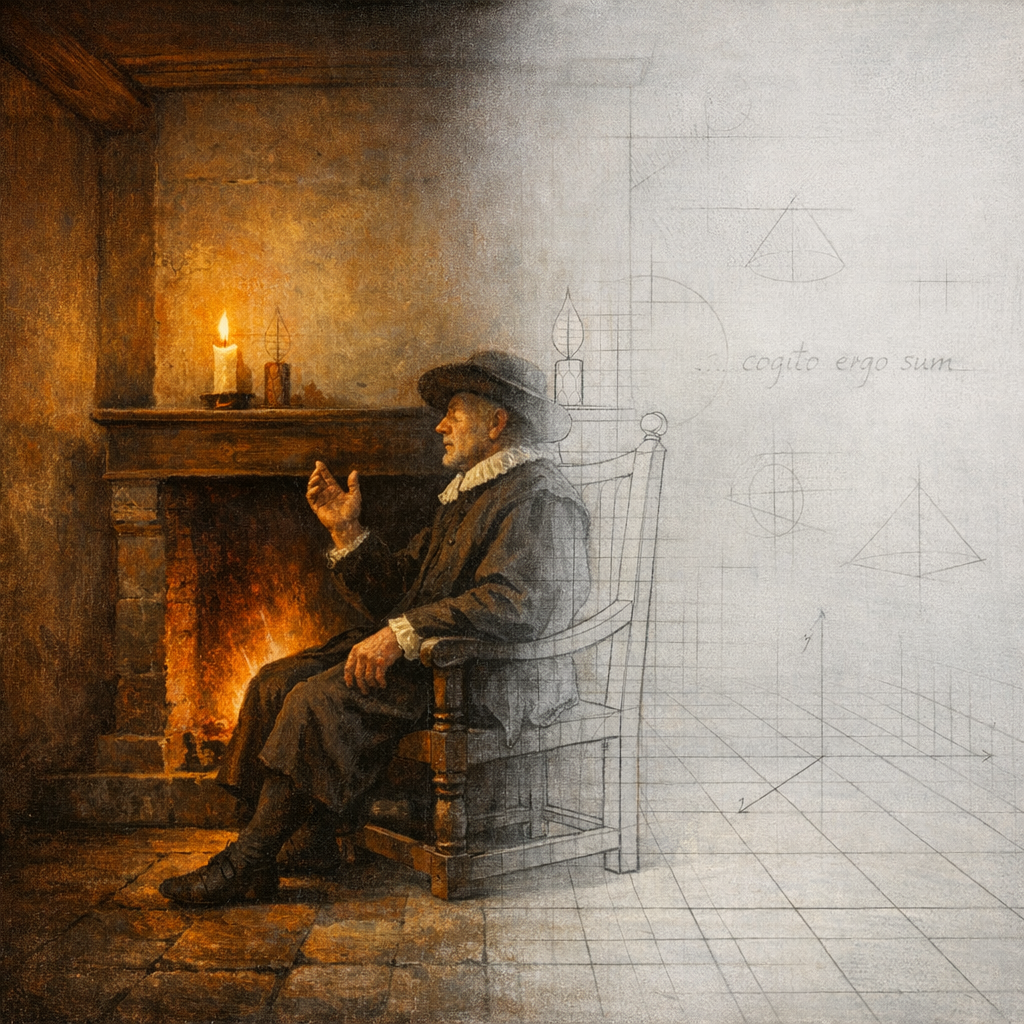
Descartes resolves to doubt everything that can be doubted. The senses deceive — perhaps the physical world is an illusion. Mathematical truths feel secure, but perhaps a malicious demon distorts even our clearest reasoning. After this systematic demolition, what survives?
But there is I know not what sort of Deceivour very powerful and very
crafty, who always strives to deceive Me; without Doubt therefore I am,
if he can decieve me; And let him Deceive me as much as he can, yet he
can never make me not to Be, whilst I think that I am.
The Inescapable Self
The very act of doubting requires a doubter. Even if an evil demon manipulates every thought, he must have something to manipulate. The existence of the thinking subject is guaranteed by the thinking itself. This is Descartes's foundation: the first truth that doubt cannot touch.
But what kind of thing is this self? Descartes argues it is purely mental — res cogitans, thinking substance. The body, the world, and all extension are distinct from this inner certainty. Here lies the root of Cartesian dualism.
Critics have long questioned whether "I think therefore I am" is valid as an inference. Perhaps only "there is thinking" is warranted — not "I think." Lichtenberg pressed this point, and Hume denied that introspection reveals any persisting self.
Related Concepts