Generation as Eternity
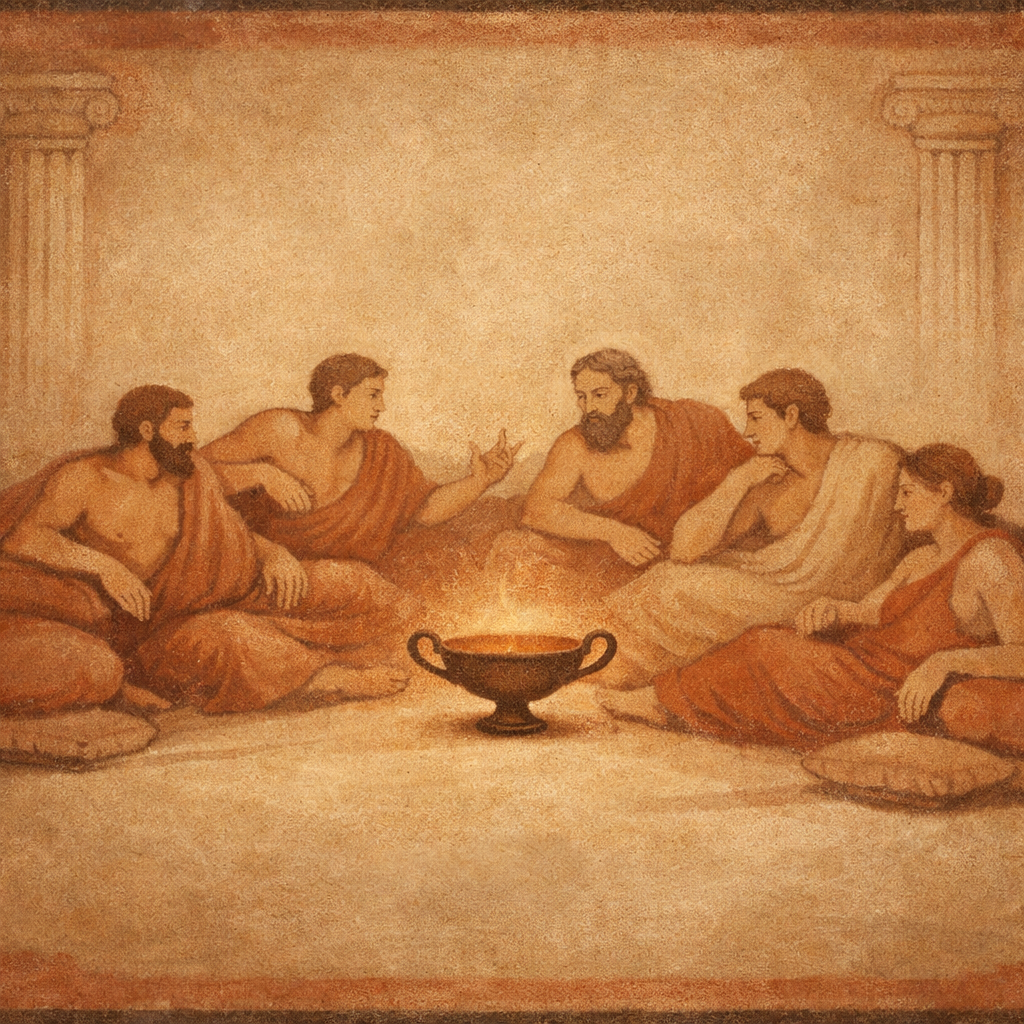
Diotima begins with an observation about all animal life: in the season of love, every creature — birds, fish, quadrupeds — is seized by a frenzy that extends beyond physical union to the nursing and defence of offspring. Even the weakest creature will battle the strongest in defence of its young. This is not, she insists, a merely physical drive. It is the expression of a metaphysical hunger: the mortal creature's attempt to perpetuate itself in time, to substitute continuity for eternity.
'Because to the mortal creature, generation is a sort of eternity and immortality,' she replied; 'and if, as has been already admitted, love is of the everlasting possession of the good, all men will necessarily desire immortality together with good: Wherefore love is of immortality.'
Pregnancy in the Soul
The theory extends beyond biology. Just as some people are pregnant in the body and seek physical offspring, others are pregnant in the soul and seek to give birth in beauty to wisdom and virtue. The creative person — the poet, the lawgiver, the philosopher — is driven by the same erotic energy as the lover, but directed toward spiritual creation. He wanders in search of a beautiful soul in which to beget the thoughts he carries within him. His offspring — poems, laws, philosophical insights — are more enduring than children.
souls which are pregnant--for there certainly are men who are more creative in their souls than in their bodies--conceive that which is proper for the soul to conceive or contain. And what are these conceptions?--wisdom and virtue in general.
The Children of Homer
Diotima asks: who would not rather have the children of Homer and Hesiod than ordinary human children? The great poets, legislators, and philosophers — Solon, Lycurgus, and all the others who ordered cities and preserved peoples — are revered as the parents of something more enduring than their own bloodlines. Their works are the true offspring of love, and the love that produced them is of a higher kind than the love that produces merely mortal children. On this account, cultural achievement is not a compensation for biological reproduction but its superior form.
Diotima's theory of erotic creativity appears in the Symposium, Chapter 6. It anticipates Aristotle's account of contemplation in the Nicomachean Ethics and connects to later philosophical treatments of artistic legacy and cultural transmission.
Related Concepts