The Philosophical Midpoint
The gods do not philosophise — they are already wise, and you cannot desire what you already possess. The ignorant do not philosophise either — they are satisfied with themselves and feel no lack. It is the person in between, who knows enough to know what is missing but lacks enough to feel the want, who genuinely seeks wisdom. This is not a comfortable position. It is the position of Love: always lacking, always pursuing, never arriving and never giving up.
No god is a philosopher or seeker after wisdom, for he is wise already; nor does any man who is wise seek after wisdom. Neither do the ignorant seek after wisdom. For herein is the evil of ignorance, that he who is neither good nor wise is nevertheless satisfied with himself: he has no desire for that of which he feels no want.
Sophia and Eros
Diotima draws the connection explicitly: wisdom (sophia) is among the most beautiful things; Love is the lover of the beautiful; therefore Love is also a lover of wisdom — a philosopher. The Greek word philosophia (love of wisdom) is not, for Plato, merely a label for an academic discipline. It names a mode of desire: the erotic orientation of a soul that finds beauty in ideas, in truth, in virtue, and in the Forms themselves. Philosophy is what eros becomes when it has been properly educated.
The Inheritance of Plenty and Poverty
Love's parentage explains the philosopher's distinctive condition. From Poros (Plenty), he inherits resourcefulness: the philosopher is bold, inventive, always finding new paths toward truth. From Penia (Poverty), he inherits the permanent lack that drives him: the philosopher is never satisfied, never in possession of the wisdom he pursues. This combination — fertile and needy, bold and insufficient — is why Socrates spends his life in conversation rather than writing treatises, claiming ignorance while demonstrating insight, and drawing others toward what he himself cannot fully grasp.
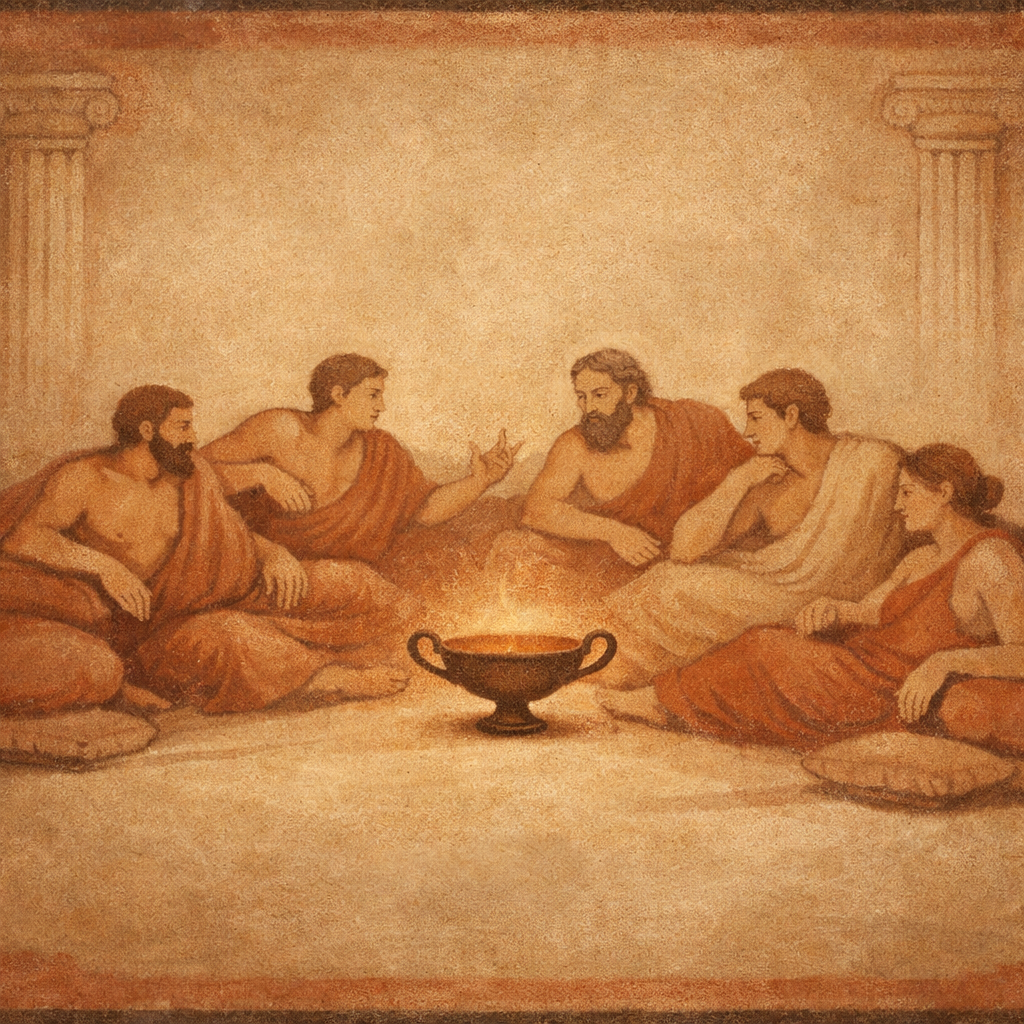
The identification of philosophy with eros appears throughout Diotima's speech in the Symposium, Chapter 6. It is the theoretical foundation for the Ladder of Beauty and explains why Plato places love, rather than argument, at the centre of philosophical education.
Related Concepts