Against the Somatic Theory of Dreams
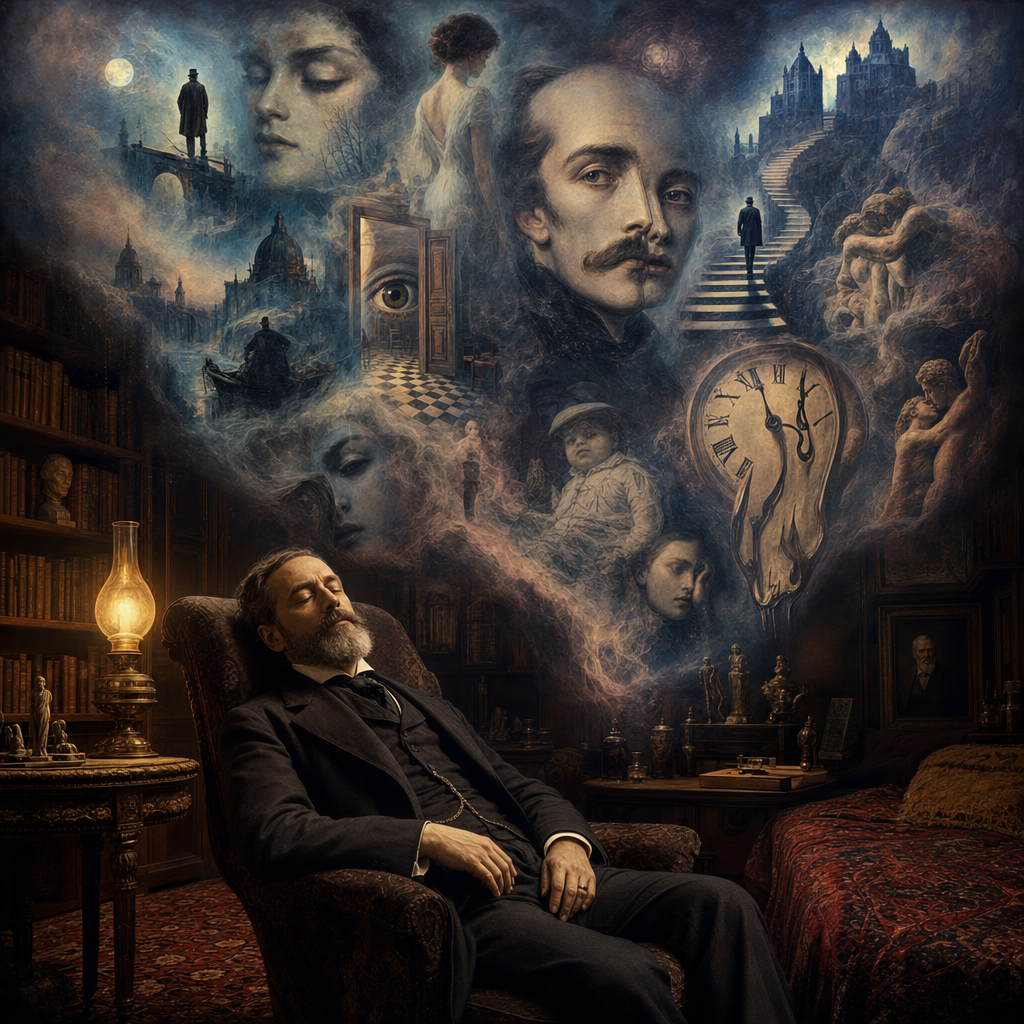
For centuries, scientists had treated dreams as the random byproducts of somatic stimulation — fragmentary impressions left by sensory noise during sleep. Freud rejects this view entirely. The dream is not biological static; it is a psychic act. Its apparent absurdity is the disguised expression of a hidden meaning, and this meaning is recoverable through a systematic method: free association followed by interpretive analysis.
Freud positions his method in explicit opposition to both the folk practice of "symbol books" (which assign fixed meanings to dream elements) and the dominant scientific view that dreams have no meaning at all. His method requires the dreamer to produce all associations to each element of the dream, however trivial or embarrassing, until the latent content emerges.
In the following pages I shall prove that there exists a psychological technique by which dreams may be interpreted, and that upon the application of this method every dream will show itself to be a senseful psychological structure which may be introduced into an assignable place in the psychic activity of the waking state.
Dreams as Senseful Structures
The key move is treating every dream as a "senseful psychological structure" with an assignable place in waking psychic life. This means the dream is continuous with — not discontinuous from — the thinking, wishing, and fearing of ordinary consciousness. Its strangeness is not evidence of meaninglessness but of disguise: the mechanisms of condensation, displacement, and secondary revision have transformed latent dream thoughts into the bizarre manifest content the dreamer recalls upon waking.
This methodological commitment — every dream is interpretable, none are exempt — is itself a philosophical claim about the structure of the mind. There is no purely somatic event in the psychic life; there are only psychic events, some of which are accessible to consciousness and some of which are not.
The method is developed through the extended analysis of Freud's own dreams and those of his patients, principally in Chapter II of The Interpretation of Dreams (1899).
Related Concepts