The Rukh and the Cicada
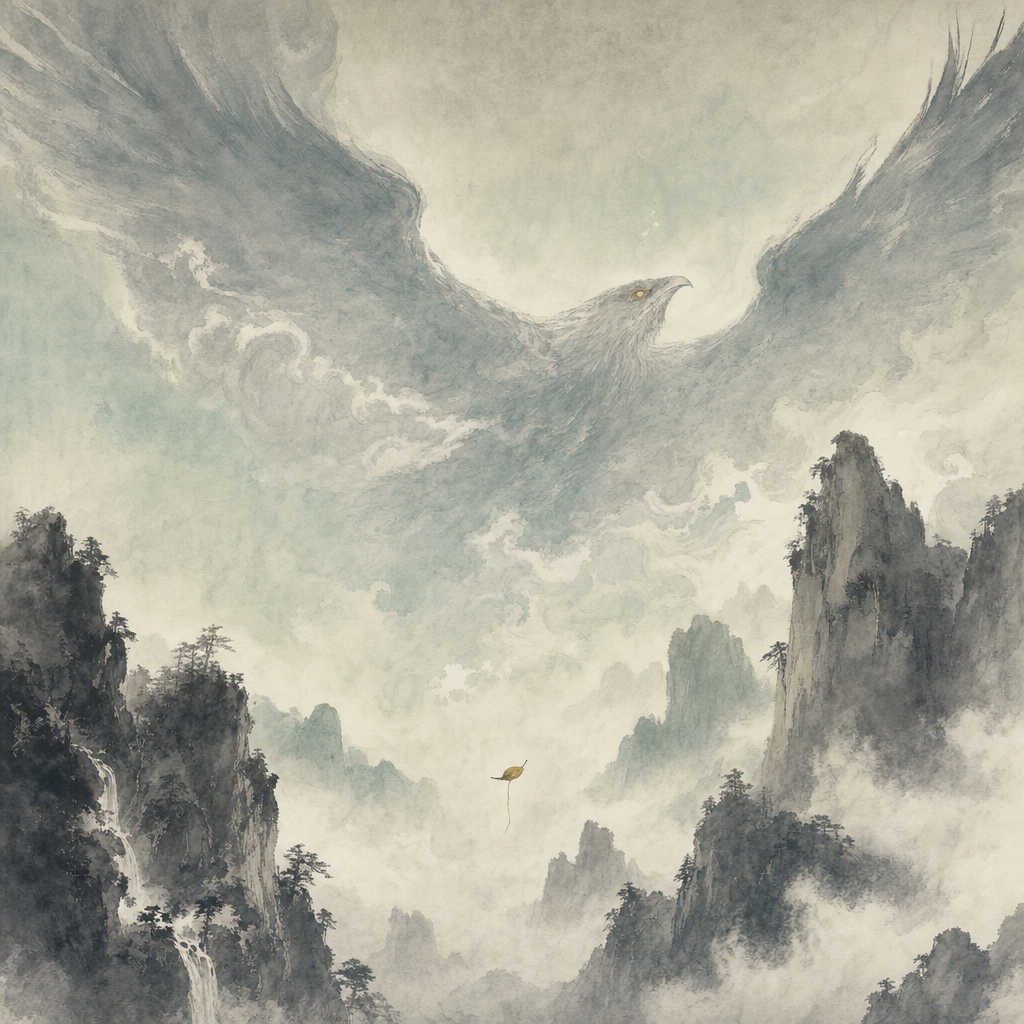
The cicada laughs at the Rukh, asking what use it is to fly so high just to travel south. Small knowledge cannot encompass great knowledge, just as a short year cannot contain a long one. The mushroom of a morning does not know the alternation of day and night; the chrysalis does not know the change of seasons. Their ignorance is not a fault — it is simply the limit of their span. The cicada's mockery is the voice of conventional wisdom deriding what it cannot imagine.
In the northern ocean there is a fish, called the Leviathan, many thousand li in size. This leviathan changes into a bird, called the Rukh, whose back is many thousand li in breadth. With a mighty effort it rises, and its wings obscure the sky like clouds.
The Usefulness of the Useless
Zhuangzi closes the chapter with the paradox of the great useless tree. A traveller sneers at a massive, gnarled tree that produces no timber. Yet the tree speaks in a dream: its very uselessness has kept it alive for centuries, safe from the axe. What the world calls useful has always been the instrument of early death. To wander free and easy is to stand outside the calculations of use and harm, to exist in the realm of what cannot be exploited.
The chapter's title — "Free and Easy Wandering" — points toward an orientation to life rather than a destination. To wander is not to be lost; it is to move without a fixed agenda, without the anxiety of arriving. The bird that rides the typhoon is not struggling against the wind. It is using what is already there, moving with the grain of things.
Chapter I of the Zhuangzi (Herbert A. Giles translation, 1889). The image of the Rukh appears again in the Liezi and influenced the Tang poet Li Bai.
Related Concepts