God as the Only Substance
Spinoza establishes that there can be only one substance — the one with infinite attributes that we call God. But he also establishes that everything that exists is either a substance or a mode of substance. Since the only substance is God, everything else — every finite thing, every human being, every physical object, every thought — is a mode of God. The world is not something God created and set loose; it is something God is, expressed in infinitely many ways.
Whatsoever is, is in God, and without God nothing can be, or be conceived.
Immanence, Not Transcendence
God is the indwelling and not the transient cause of all things.
The traditional theistic God is transcendent — separate from and above the creation, acting on it from outside. Spinoza's God is immanent: God does not stand apart from the world and make things happen in it; God is the immanent ground of all that happens. Nature viewed as active — as the productive, generative power — is God under one description. Nature viewed as passive — as the produced world of finite things — is also God, expressed in modes. The two are not different things but two ways of understanding the one infinite reality.
Necessity, Not Freedom
This God does not choose, deliberate, or act out of purposes. Everything that follows from God's nature follows necessarily — as necessarily as the properties of a triangle follow from its definition. The traditional picture of a personal God who creates freely, intervenes in history, and responds to prayer is, for Spinoza, a confusion born of anthropomorphism: we project onto infinite reality the features of finite minds, and imagine a divine personality where there is only infinite necessity. Deus sive Natura is not a being who could have made the world otherwise — it is the world as it necessarily is, understood at its deepest level.
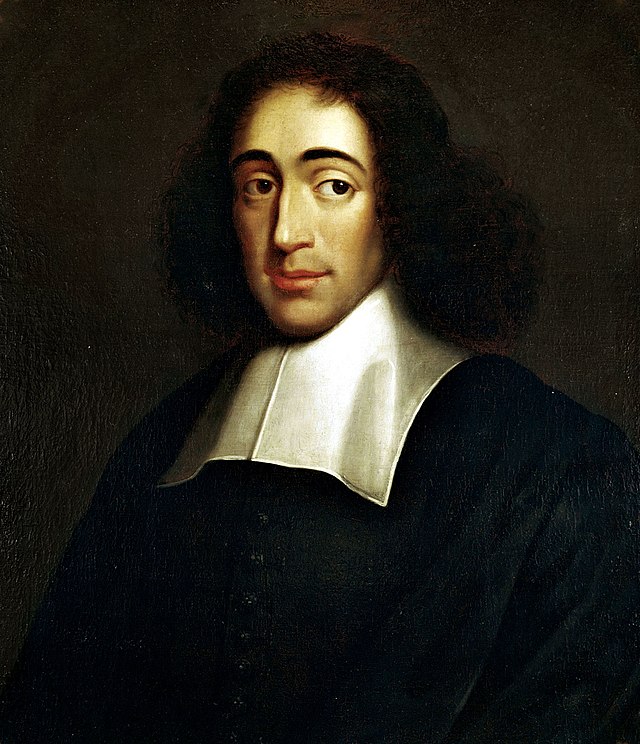
The identification of God and Nature is worked out in Propositions XIV and XV of Part I of the Ethics, and the distinction between natura naturans (nature as active/God) and natura naturata (nature as passive/the world of modes) is explained in the note to Proposition XXIX. Spinoza was excommunicated from the Amsterdam Jewish community in 1656, partly on account of views that anticipated those of the Ethics.
Related Concepts