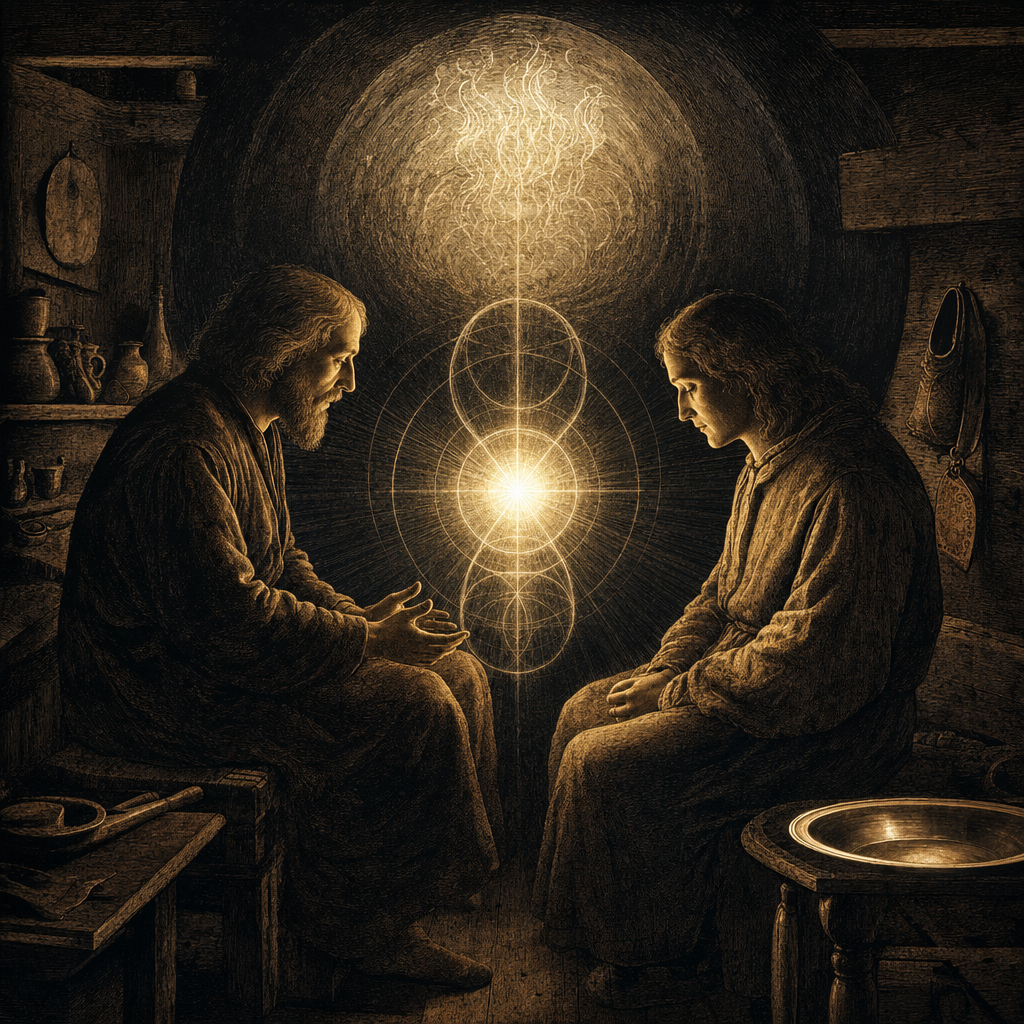
Why Detachment Surpasses Love
Love, Eckhart argues, is an outward movement: it stretches toward the beloved and is thereby shaped by the beloved's nature. Humility bends downward; mercy reaches across to the suffering. All are admirable, but all involve a kind of dependency on what is outside the soul. Detachment, by contrast, is pure introversion: it does not move toward anything but withdraws from everything, becoming utterly still. In this stillness it most resembles God, who is not moved by anything outside himself.
The Unmoved as Most Real
Behind this argument is a Neoplatonic metaphysics: that which is most real is most unchanging. God is pure being, pure act, and absolutely immovable in the sense of being self-sufficient — needing nothing, moved by nothing. The soul that achieves detachment participates in this immovability. It becomes, as Eckhart says, a pure nothing that is at the same time a pure something: released from all determination, it is open to receive the fullness of divine being.
God Compelled
Eckhart's most striking claim is that the detached soul compels God — literally forces the divine to act within it. This is because God's nature is to communicate himself to whatever can receive him without obstacle, and total detachment removes every obstacle. The soul in this state does not entreat God; it simply is the kind of thing that God must fill. Eckhart puts it with characteristic bluntness: God cannot resist an empty vessel.
Nothingness as Fullness
The paradox of detachment is that the soul becomes nothing in order to become everything. By releasing every particular identity — every preference, attachment, and self-description — it opens itself to the whole of being. This is not nihilism: the nothing of detachment is not emptiness in a negative sense but the pure potentiality that underlies all actuality. The detached soul mirrors the divine abyss (Abgrund) from which all things flow.
On Detachment (Über die Abgeschiedenheit) has been attributed to Eckhart since the medieval manuscripts, though some scholars have questioned its authenticity. Its argument is consistent with the German Sermons and is commonly included in standard editions of Eckhart's works.
Related Concepts