The Argument
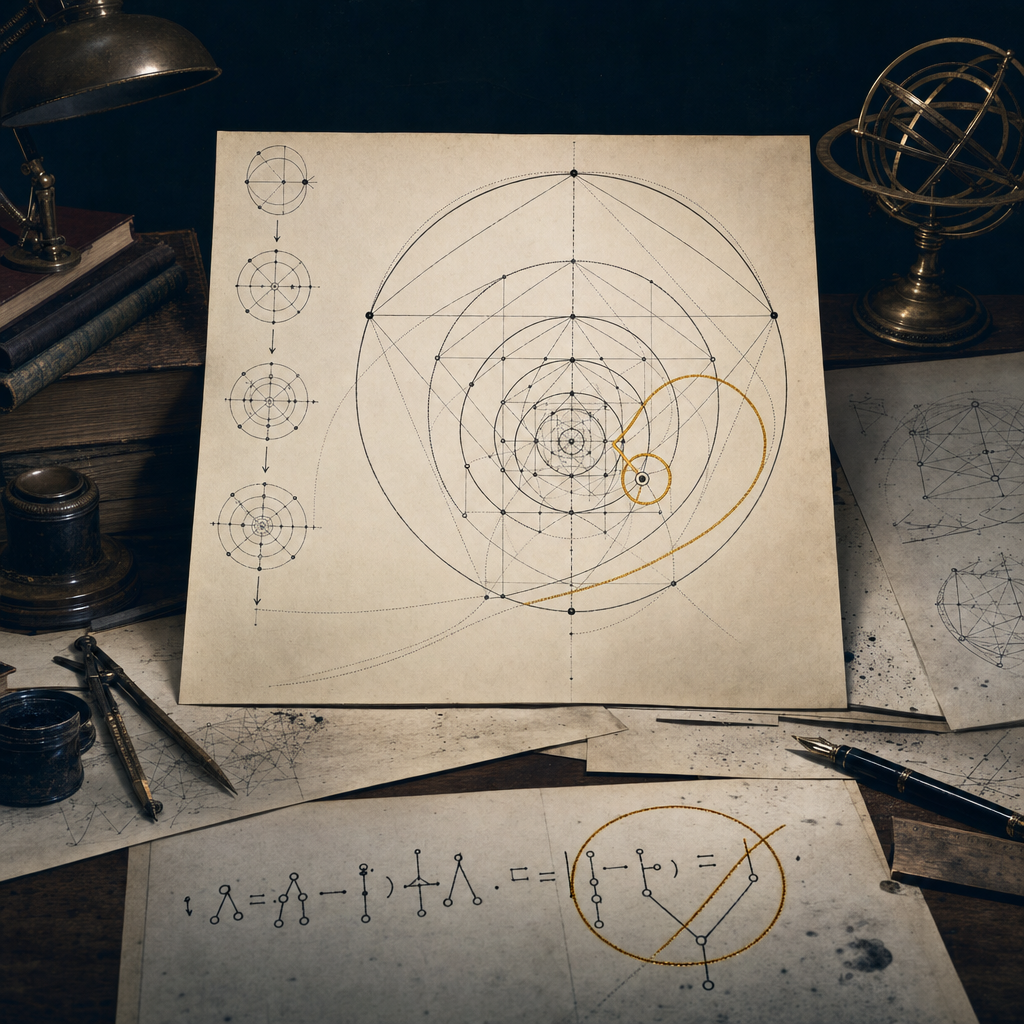
Bradley's argument proceeds in two stages. First: a relation between two terms requires something to connect them — it cannot merely float between them without attachment. But the connection between the relation and each term is itself a relation, which in turn requires a further connecting relation, and so on without end. The attempt to explain the unity of a relational fact by appeal to a relation generates an infinite regress rather than an explanation. Second: if we try to avoid the regress by saying that terms and their relation form an organic unity that does not require further cement, we have abandoned the relational picture entirely — the unity we invoke is exactly the kind of non-relational whole that Bradley says is ultimate.
The Target: Pluralism and External Relations
Bradley's argument is specifically directed against the view — defended by Leibniz, Hume, and later by Russell — that the world is fundamentally a plurality of independent terms standing in external relations. An external relation is one that does not affect the intrinsic nature of the terms it relates: A can stand in any number of external relations to B while remaining intrinsically unchanged. Bradley argues that this picture is incoherent: relations must either be internal (modifying the nature of the terms), in which case they cannot be external, or they are genuinely external, in which case they cannot really connect the terms at all.
The Analytic Response
Russell's response to Bradley — which he developed in "The Principles of Mathematics" (1903) and subsequent works — is that the regress Bradley generates is benign, not vicious. The fact that the relation R holds between a and b does not require a further relation R' between R and a, and another R'' between R' and a, and so on: aRb is a complete fact that does not call for further explanation of how R is attached to its terms. This exchange between Bradley and Russell — which crystallised the distinction between idealism and the new analytic realism — shaped British philosophy for the entire twentieth century.
The critique of relations is central to Chapters II–III of Appearance and Reality (1893). Russell's explicit response in "The Principles of Mathematics" (1903) and the subsequent exchange between Bradley and Russell is one of the founding controversies of analytic philosophy.
Related Concepts