The Structure of the Argument
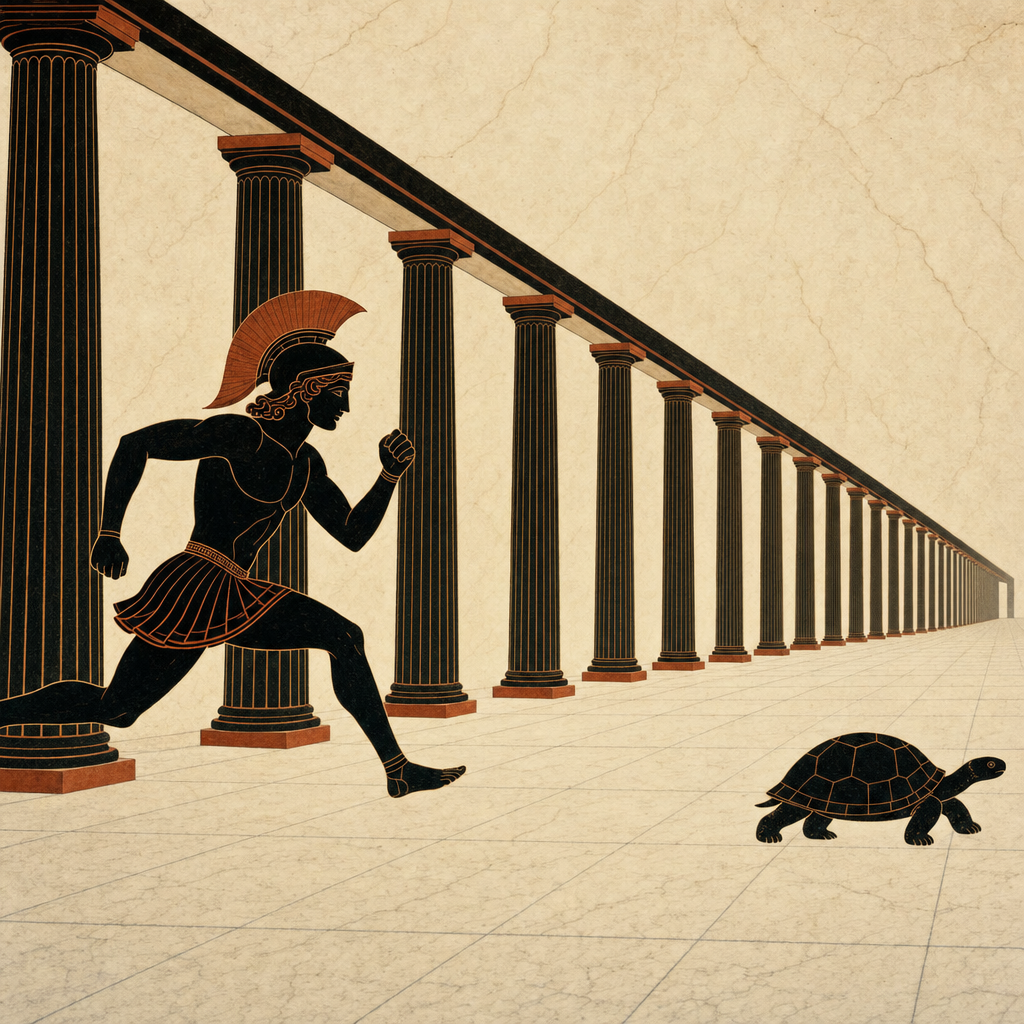
Zeno assumes that space is infinitely divisible: between any two points there is always a midpoint. From this apparently innocent premise, the argument constructs an infinite series of tasks that Achilles must complete before catching the tortoise. He must reach the 1/2-way mark, then the 3/4-way mark, then the 7/8-way mark, and so on — an endless sequence. The conclusion is not that Achilles moves slowly but that he cannot move at all, or that motion as ordinarily conceived — as the traversal of continuous space in finite time — is logically impossible.
Aristotle's Response
Aristotle distinguished between actual and potential infinity. An infinite series, he argued, need not be actually traversed but only potentially divisible: Achilles does not face infinitely many distinct tasks, because the infinite sub-divisions are potential, not actual. Aristotle also noted that if space is infinitely divisible, so is time — and an infinite series of diminishing time-intervals can sum to a finite duration. This response anticipates the mathematical theory of convergent series, but Zeno's defenders argue that it merely re-describes the puzzle without resolving the deeper question of what it means for motion to be real.
The Modern Perspective
Cantor's set theory and the rigorous formulation of limits in the nineteenth century gave mathematicians tools to sum infinite series: 1/2 + 1/4 + 1/8 + … = 1. Achilles catches the tortoise at a well-defined point after a finite time. But philosophers note that the mathematical solution tells us how to calculate when Achilles arrives without explaining how he completes infinitely many sub-tasks. The paradox survives in philosophy of mathematics and metaphysics as a question about the nature of the continuum, the reality of infinite processes, and the relationship between mathematical abstraction and physical reality.
The paradox is reported by Aristotle in Physics VI.9 and by Simplicius in his commentary. It has been discussed by every major philosopher of mathematics, from Leibniz and Berkeley to Bertrand Russell, who called it one of the most subtle and far-reaching contributions to the philosophy of motion ever made.
Related Concepts