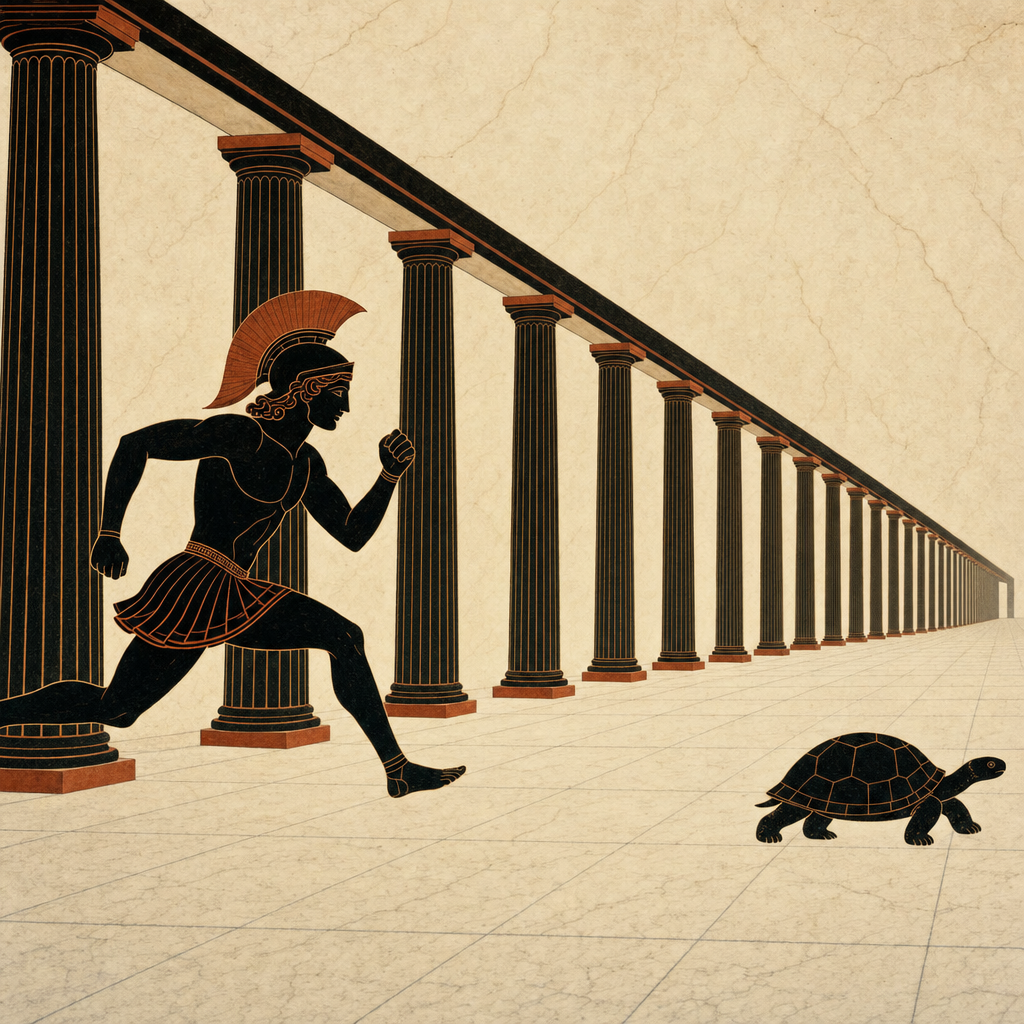
Zeno of Elea's philosophical legacy survives not as a finished treatise but as a set of arguments — the paradoxes — reconstructed from Plato's Parmenides, Aristotle's Physics, and later commentators. Zeno was a student of Parmenides and wrote his arguments as a defence of his teacher's monism: if reality is truly one, indivisible, and unchanging, then the common-sense world of many things and motion must be an illusion. The paradoxes are designed to show that assuming plurality and motion leads to contradiction. In the paradox of Achilles and the Tortoise, the faster runner can never overtake the slower if the slower has a head start, because the faster must first reach the point the slower has left — but by then the slower has moved on, and so on infinitely. The Arrow paradox argues that a moving arrow is always at rest, since at any given instant it occupies a definite position. The Dichotomy argues that before reaching any destination you must first reach the halfway point, and before that the quarter-way point, and so on — an infinite regression that makes motion impossible to begin. These arguments have occupied mathematicians and philosophers for two and a half millennia, from Aristotle's first responses to Cantor's theory of infinite sets and modern topology.
This work isn't available here yet. In the meantime you can purchase a copy on Amazon, or check back later, as we are always adding books to our library.
As an Amazon Associate we earn from qualifying purchases.