The Veil of Maya
Schopenhauer inherits from Kant the insight that what we encounter in experience is never the thing-in-itself but always the phenomenon — the thing as it appears through the forms our mind imposes on it. Space, time, and the law of causality are not features of the world discovered by inquiry; they are the very conditions under which anything can appear to us at all. The world we inhabit is thoroughly shaped by the subject that perceives it. In borrowing the Hindu concept of maya — the veil of illusion — Schopenhauer gives this Kantian point a darker, more existential weight: ordinary consciousness is a kind of enchantment, mistaking the veil for reality itself.
Subject and Object as Correlates
Representation requires both poles: no object without a subject, no subject without an object. The knowing subject — the pure "I" that underlies all experience — is never itself an object in its own world; it is always the unseen eye of cognition. This subject is not a thing among other things but the condition for the existence of the entire representational world. Yet it is also entirely empty: it has no properties, no location, no duration. The apparent paradox — that the subject is everything and nothing — is one of the deepest puzzles of Schopenhauer's first book.
The Limits of the Principle of Sufficient Reason
Within the world as representation, the principle of sufficient reason governs absolutely: every change has a cause, every proposition has a ground, every mathematical truth has a demonstrative basis. But this principle is the organising law of the representational world, not of reality as such. Science, history, and mathematics are all elaborations of this principle — they explore the structure of the veil with increasing rigour. But they can never penetrate it. The question of what the world is beyond representation demands a different kind of inquiry entirely, which is why the first book of the work must give way to the second.
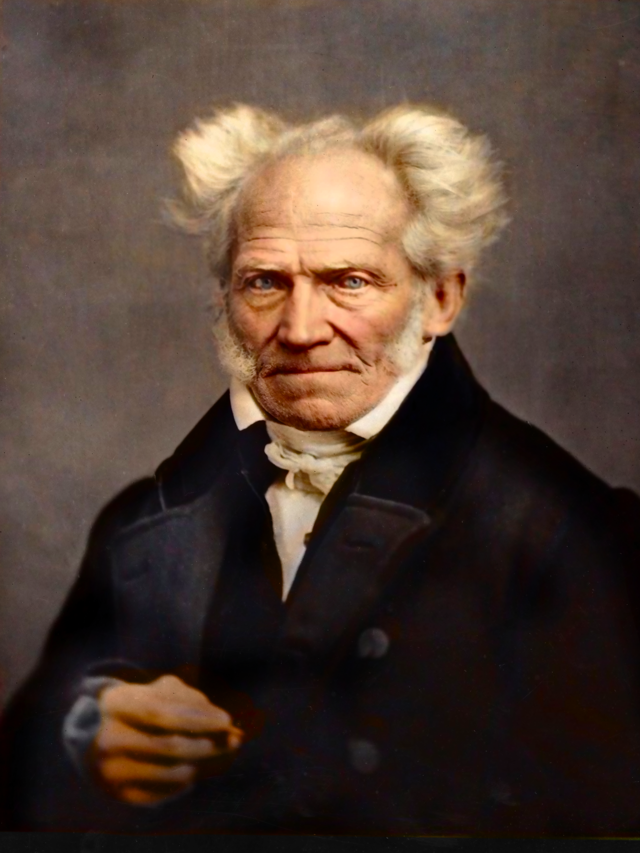
The proposition "The world is my representation" opens the first book of The World as Will and Representation (1818/1844). The debt to Kant's transcendental idealism is explicit throughout, though Schopenhauer consistently criticised what he regarded as inconsistencies in Kant's account of the thing-in-itself.
Related Concepts