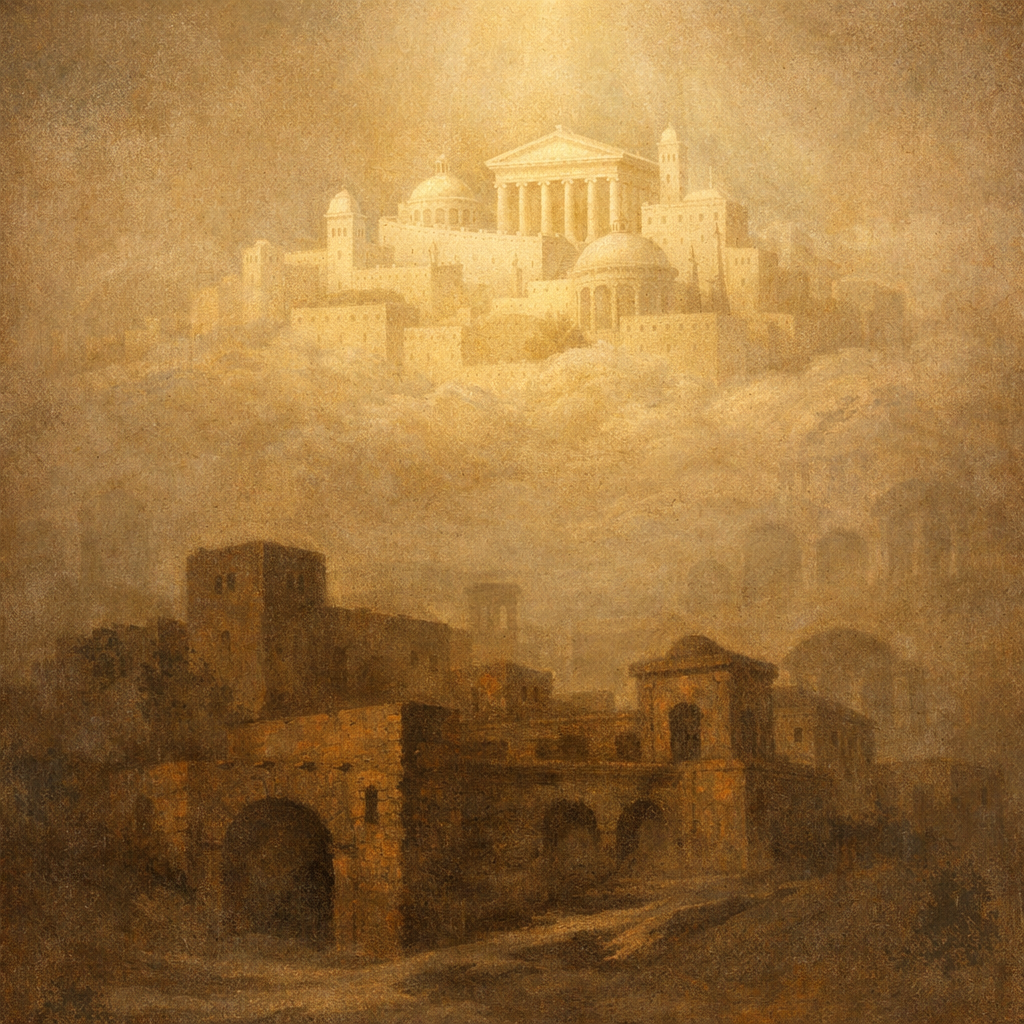
Two Loves, Two Cities
Augustine's argument begins with a deceptively simple observation: human beings can live in two fundamentally different ways — according to themselves, or according to God. Those who live for themselves, taking their own desires, ambitions, and judgments as the measure of all things, belong to the earthly city. Those who live for God belong to the city of God. These are not two geographical locations or two historical empires — they are two communities of love, mingled together throughout history, distinguishable only to God.
because some live according to the flesh and others according to the spirit there have arisen two diverse and conflicting cities
The earthly city is not simply Rome or any particular state — it is the whole community of those who seek their final rest in earthly goods: glory, power, wealth, pleasure. The city of God is the community of those who seek their rest in God alone, and who use earthly goods as pilgrims use a road: with gratitude, but without making it their final home. The two cities are not distinguished by what they suffer, but by what they love.
Pride as the Founding Vice
At the root of the earthly city is pride — not pride in the ordinary sense of self-confidence, but the metaphysical corruption in which the soul makes itself the centre of its own world. When the soul turns away from God, it ceases to seek its satisfaction in the highest good and begins to seek it in itself. This is the original sin: not merely the eating of fruit, but the prior movement of the will toward self-sufficiency — the desire to be a god without God.
And what is pride but the craving for undue exaltation? And this is undue exaltation, when the soul abandons Him to whom it ought to cleave as its end, and becomes a kind of end to itself.
The Two Cities in History
The two cities are not simply the church and the state. Many who are formally members of the church belong by their loves to the earthly city; many who are outside it are, by God's grace, citizens of the city of God. The distinction runs through every institution, every heart. History is the long story of these two communities living alongside one another, sometimes in cooperation, sometimes in conflict — until the final judgment separates them definitively.
This is why Augustine refuses to identify the sack of Rome with the judgment of God on Rome alone, or the church's prosperity with God's approval. History is not a simple morality tale. The two cities are mixed; the wheat and the tares grow together until the harvest. What Augustine offers is not a political program but a hermeneutic — a way of reading the whole of history as the drama of two loves competing for the human heart.
The doctrine of the two cities is developed throughout the work but stated most clearly in Books XIV and XIX. The phrase "love of self even to contempt of God / love of God even to contempt of self" appears in Book XIV, chapter 28.
Related Concepts