Production Without Activity
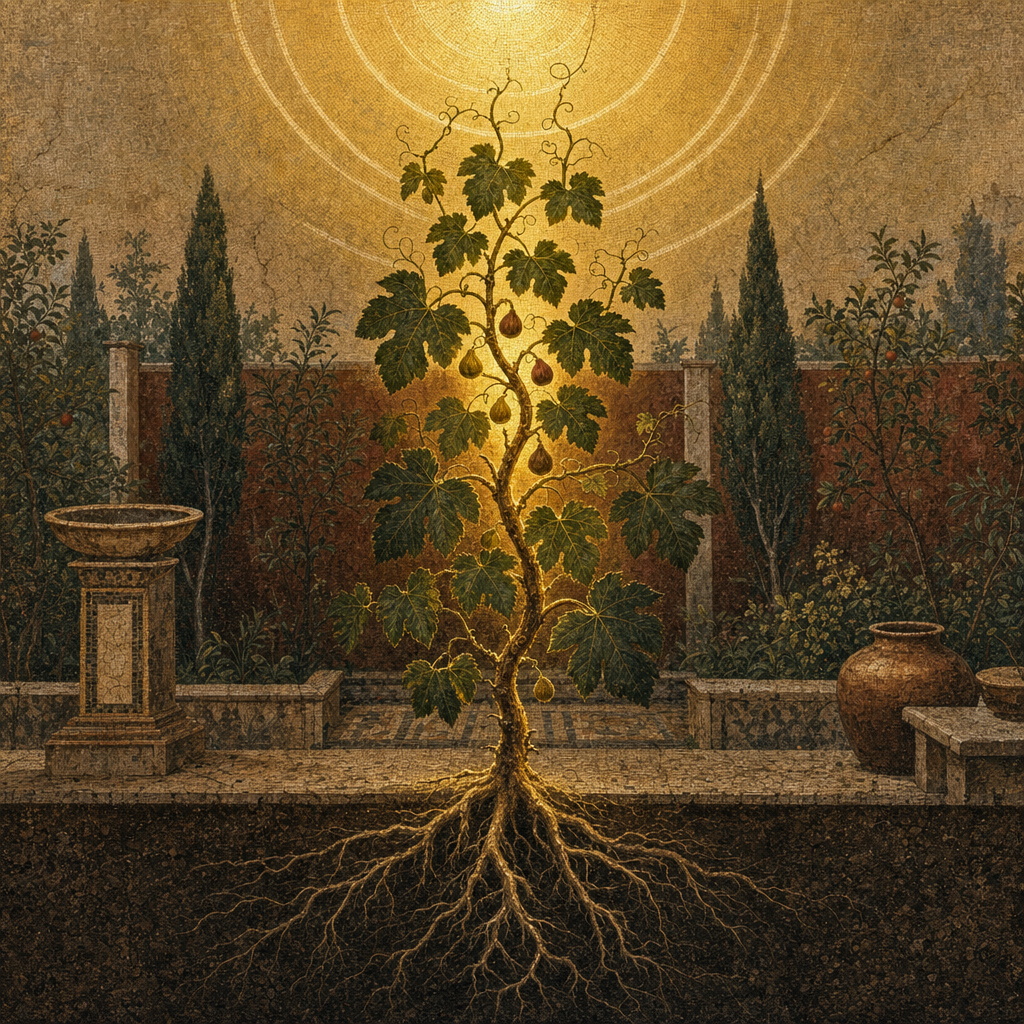
How can something produce without acting? Plotinus's answer is that the One does not produce Intellect by doing anything; Intellect arises from the One as light arises from the sun — not because the sun reaches out or intends to illuminate, but simply because it is the nature of light to radiate from a luminous source. The sun's activity is not diminished by its radiation, nor is its stillness interrupted. Similarly, the One's absolute self-sufficiency overflows into Intellect as a necessary consequence of what the One is. The production is real, and its products are real, but the One is in no way changed, depleted, or activated by it.
Stillness and Perfection
Activity, for Plotinus, is always a sign of need: things act because they lack something and are trying to acquire it or express it. The more perfect a being, the less it needs to do. Intellect must contemplate to constitute its content; Soul must administer to express its life; human beings must act constantly to maintain themselves in the world. The One, being absolutely perfect and without any lack, does nothing at all — and precisely in doing nothing, it generates everything. This paradox is at the heart of Plotinus's metaphysics: the most real is also the most still; the most powerful is also the most at rest.
The Silence at the Centre
For the philosopher who has ascended to the threshold of union with the One, the discovery of the One's stillness is not the discovery of an abstract principle but an experience. The frenetic activity of ordinary life — the noise of desires and anxieties and plans — falls silent as the soul approaches its source. What remains is not emptiness but a silence that is fuller than any noise, a stillness that is more alive than any motion. The mystic's experience of interior silence is, for Plotinus, not a psychological peculiarity but a contact with the actual nature of the first principle — the stillness that underlies and makes possible all the movement and becoming of the world.
The paradox of the One's productive stillness is developed throughout the Enneads, most directly in III.8 and VI.9. The comparison to the sun's radiation is one of Plotinus's most frequently deployed images. The tradition of identifying the mystical interior silence with the nature of the first principle runs from Plotinus through Pseudo-Dionysius, Meister Eckhart, and John of the Cross.
Related Concepts