The Paradox of Plurality
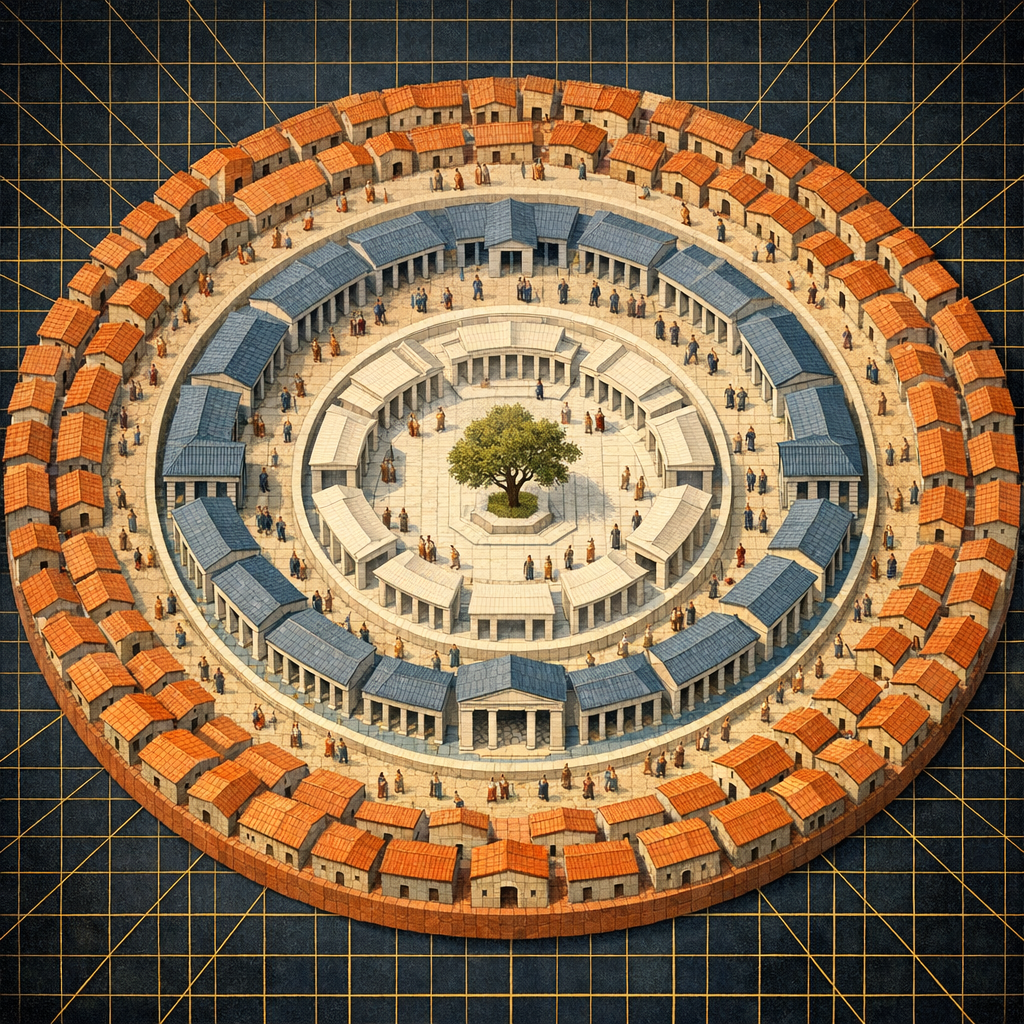
Zeno's argument against plurality runs as follows. If there are many things, each thing must be a unit — one thing, not two or more. But for a thing to have magnitude (to occupy any space at all), it must be divisible into parts, and those parts must themselves have magnitude, and so on without end. So each thing is infinitely large. But also: if the things are units, they have no magnitude at all (a truly indivisible unit would have zero size), and so all the many things together would have zero size. The many things are, simultaneously, infinitely large and infinitely small. Plurality entails contradiction; therefore there cannot be many things.
Parmenides and the Defence of the One
Zeno's arguments are designed to support the Eleatic monism of his teacher Parmenides. Parmenides had argued that Being is one, whole, motionless, and eternal, and that the changing, plural world of sense experience is an illusion generated by human opinions that mistake appearance for reality. Zeno's contribution was strategic and dialectical: rather than directly arguing for Parmenides's conclusions, he showed that accepting the pluralism of ordinary experience generates worse contradictions than accepting the seemingly paradoxical Parmenidean One. The paradoxes are weapons against opponents, not direct expressions of positive doctrine.
Legacy for Metaphysics
The paradoxes of plurality anticipate problems that recur throughout the history of metaphysics: the problem of the composition of material objects from parts, the question of whether material things have ultimate indivisible constituents (atoms), and the relationship between mathematical structures and physical reality. Democritus responded to Zeno by postulating genuine atoms — indivisible units with magnitude. Plato addressed the Eleatic challenge in the Parmenides and Sophist. Modern philosophy of physics encounters Zeno's questions again in the debate over whether space and time are continuous or discrete, and whether quantum mechanics reveals a granular rather than continuous structure to physical reality.
The arguments against plurality are reported by Simplicius in his commentary on Aristotle's Physics, preserving fragments that may be verbatim from Zeno's original text. They are among the earliest surviving examples of rigorous reductive argument in Western philosophy.
Related Concepts