From Geosphere to Noosphere
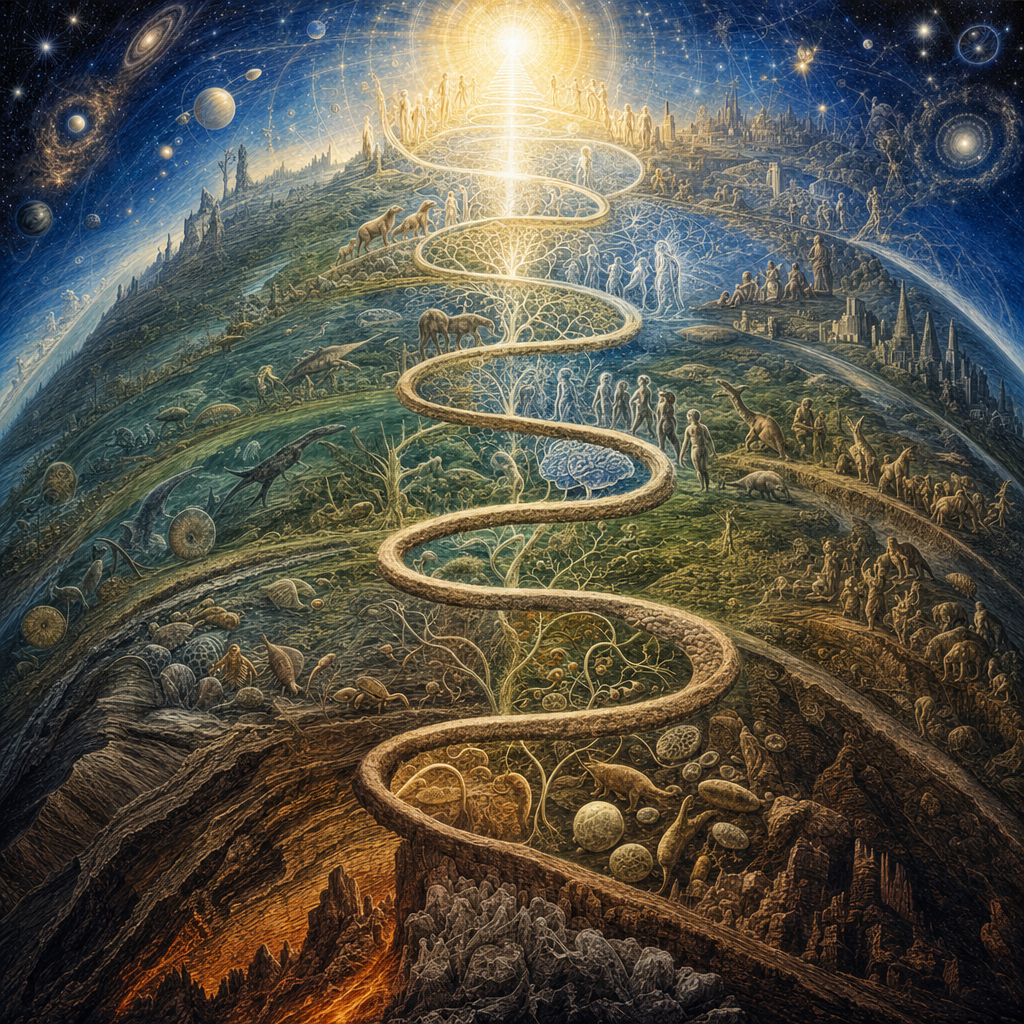
Teilhard traces three great stages in Earth's history, each constituting a new "sphere." The geosphere is the layer of inorganic matter — rock, mineral, ocean. The biosphere is the living envelope produced when matter organises itself into self-replicating, metabolising systems. The noosphere emerges when reflective consciousness appears: when life becomes aware of itself, when evolution becomes conscious of its own direction. With the human, the planet acquires a thinking layer.
Thinking Together
The noosphere is not merely the sum of individual human minds but an increasingly interconnected and mutually reinforcing network of thought. Teilhard traces its development through language, writing, printing, and communication technology — each advance knitting the noosphere more tightly together, enabling individual minds to build on each other's work across time and space. The noosphere is evolving toward greater integration, not mere accumulation.
The Noosphere Today
Teilhard's concept has proven remarkably prescient. The emergence of the internet, global communication networks, and collective intelligence research all suggest the literal reality of a planetary mind. Whether or not one accepts Teilhard's theological framework, the noosphere names something real: the increasingly total envelopment of the planet by networked human intelligence, with consequences — for climate, for politics, for culture — that no individual mind could produce or predict.
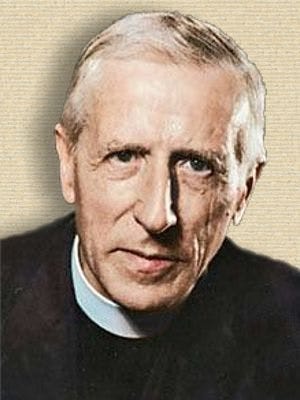
The noosphere concept was developed in parallel by Teilhard and his friend Vladimir Vernadsky, the Ukrainian geochemist. Teilhard introduced it in his 1925 essay "Hominization" and developed it throughout The Phenomenon of Man.
Related Concepts