Against the Static Cosmos
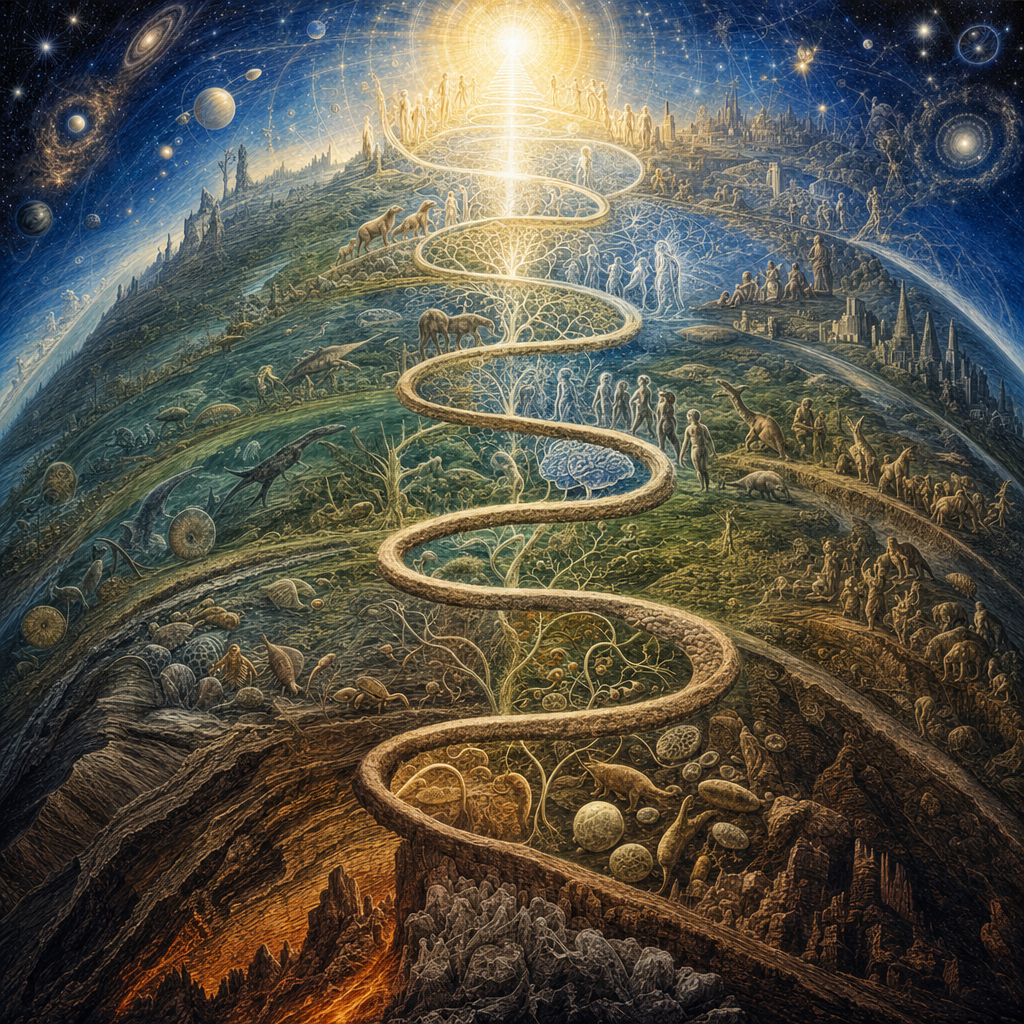
Traditional theology and much traditional philosophy assumed a static cosmos: the world as created in its essential form by God, with history as merely the stage on which human salvation is enacted. For Teilhard, this is the root error. Evolution reveals that the cosmos is not a stage but a story — not a backdrop for human drama but a drama in itself, with a direction, a plot, and an as-yet-unfinished ending. Cosmogenesis replaces cosmology as the basic category.
The Law of Complexification-Consciousness
The direction of cosmogenesis is governed by what Teilhard calls the law of complexification-consciousness: as material systems become more complex in their organisation (more interconnected, more differentiated), they simultaneously develop greater interiority, awareness, and consciousness. The two variables track each other across all of evolutionary history — from subatomic particles through molecules, cells, organisms, and brains to the noosphere. This law is Teilhard's alternative to both mechanism (which denies interiority) and vitalism (which requires a special life-force).
Orthogenesis and Radial Energy
Teilhard distinguishes two kinds of energy in evolution. Tangential energy maintains a system at its current level of organisation — the energy of chemistry and thermodynamics. Radial energy drives a system toward greater complexity and consciousness — the energy of evolution's direction. Teilhard calls this directed evolutionary movement orthogenesis: evolution is not random in its ultimate effect but moves along a privileged axis toward the Omega Point. Whether this directedness is built into matter from the beginning or imposed from ahead by the Omega attractor is a question Teilhard leaves productively open.
Cosmogenesis as a concept is developed throughout The Phenomenon of Man and revisited in Christianity and Evolution, where Teilhard explicitly contrasts it with the static cosmos assumed by traditional theology.
Related Concepts