The Analogy with Medicine
Cicero opens the Tusculans by comparing philosophy to medicine. Medicine cures the body's diseases; philosophy cures the soul's. The soul's diseases are false beliefs — errors about what is really good or bad, what is worth fearing, what is genuinely pleasurable. Just as the sick body requires the physician's skill to diagnose and treat its condition, the disturbed soul requires the philosopher's art to identify the mistaken beliefs generating its distress and to replace them with true ones. Philosophy is not a luxury for those with leisure but a necessity for any person who wants to live well.
The Sources of Distress
Cicero identifies the four cardinal passions of Stoic psychology — distress (aegritudo), fear (metus), pleasure (laetitia), and desire (libido) — as the sources of psychological suffering. Each passion rests on a false belief: distress on the belief that something bad has happened to you; fear on the belief that something bad is about to happen; pleasure on the belief that something genuinely good is present; desire on the belief that something genuinely good is absent. Since the Stoics hold that only virtue is genuinely good and only vice genuinely bad, all four passions rest on errors about value — errors that philosophical reasoning can correct.
Consolation and the Examined Life
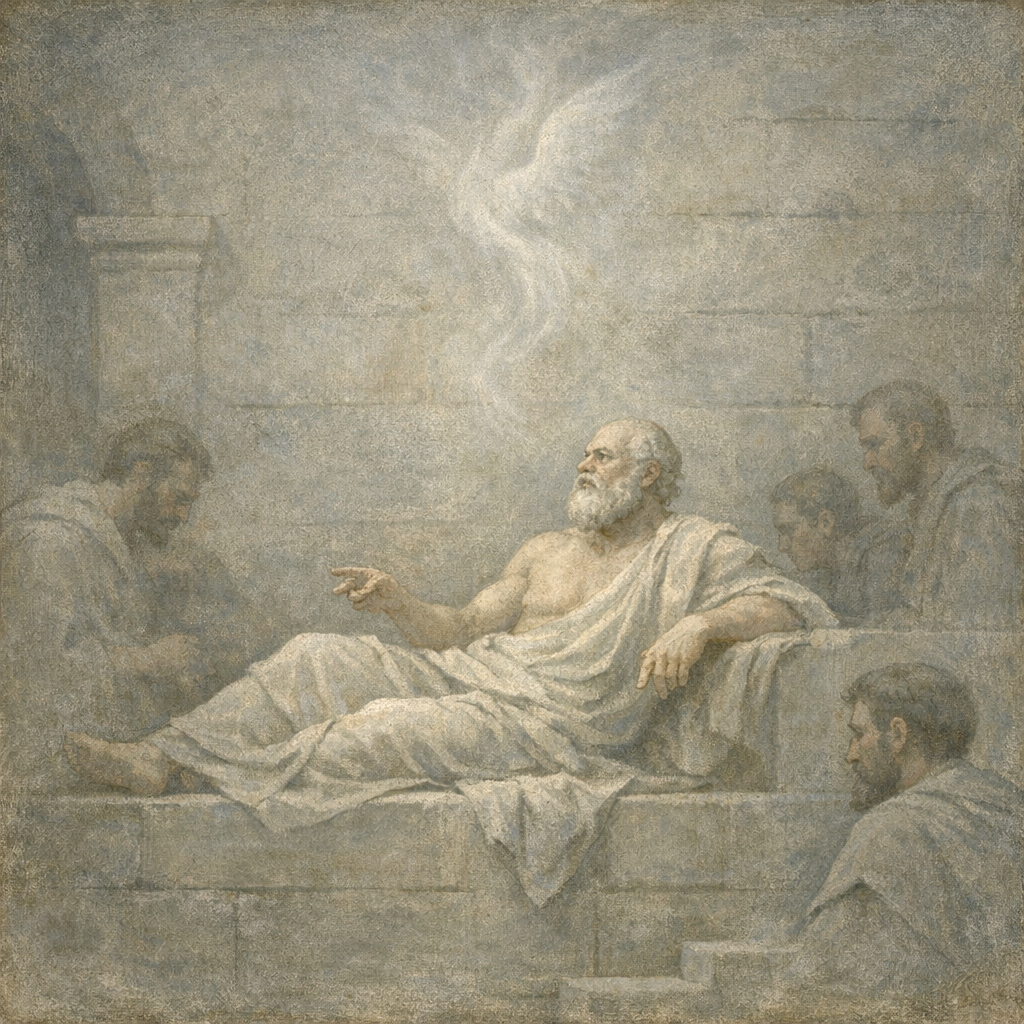
Cicero practises the therapeutic method throughout the Tusculans, composing what amounts to a manual of philosophical consolation. Against the fear of death, he marshals Platonic arguments for the immortality of the soul alongside Epicurean arguments that death is simply annihilation and therefore not harmful. Against grief, he examines the Stoic and Peripatetic accounts of how emotions should be moderated. The book as a whole enacts the claim that reflective, carefully reasoned engagement with philosophical argument is itself a healing activity — that thinking through the reasons for one's distress, rather than either suppressing it or indulging it, is the distinctively rational response to the human condition.
The Tusculan Disputations were written in the summer of 45 BC, immediately after the death of Tullia. The form — a dialogue between a "Master" and an anonymous "Hearer" who proposes theses for the master to refute — is Cicero's own invention, modelled loosely on the Academic disputatio. The book was enormously influential on Christian consolatory literature from Boethius onward.
Related Concepts