The Problem of Life
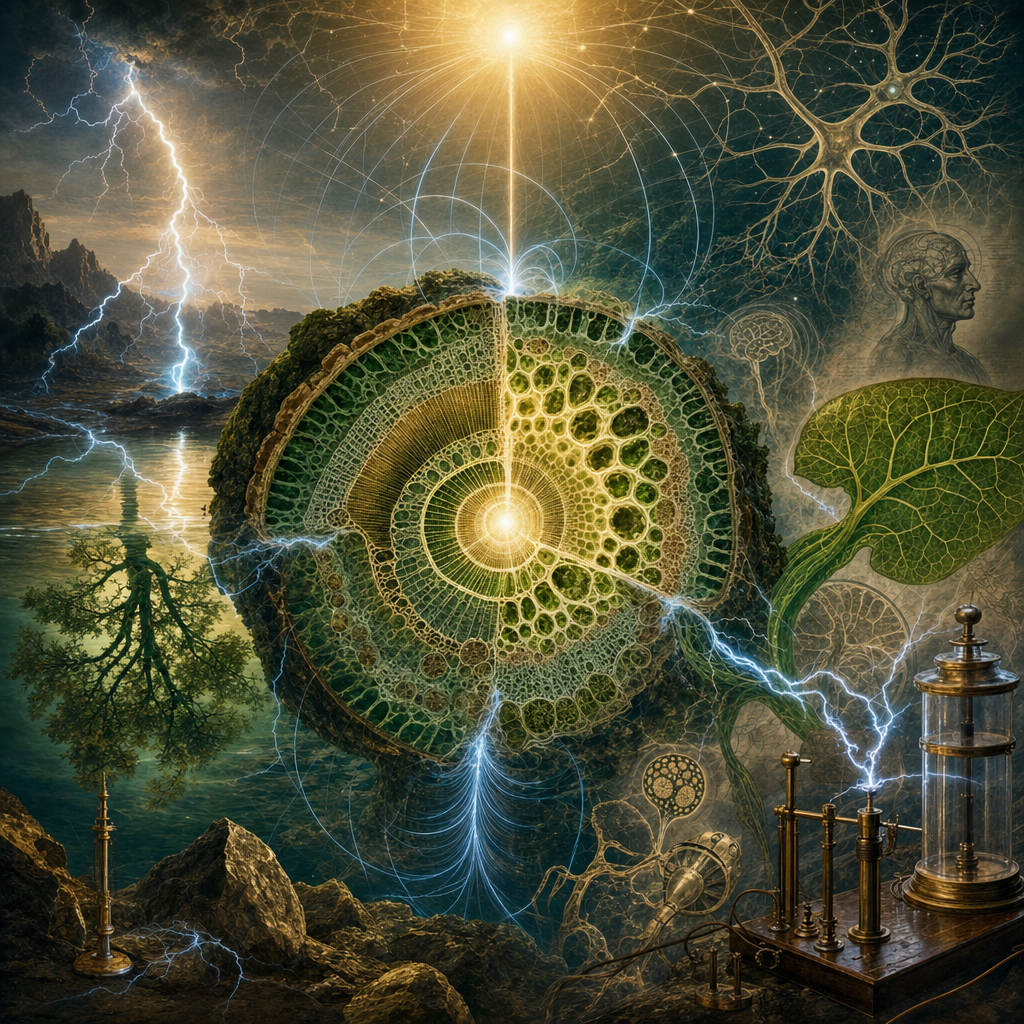
Mechanism explains the behaviour of a system by decomposing it into its parts and tracing the causal interactions among them. This works well for billiard balls and clockwork. It fails, Schelling argues, for living things — because in a living organism the parts exist and function only in relation to the whole. A heart outside a body is not a heart performing its function; it is an inert lump of tissue. The organism is not built up from pre-existing parts; rather, the whole is logically and causally prior to the parts, which it continually generates and organises.
Self-Organisation as a Philosophical Category
Schelling articulates what we would now call self-organisation as a genuine philosophical category irreducible to mechanism. The organism produces itself — Schelling uses the term Organisation to capture this reflexive, self-referential character. It maintains its form through a continuous process of material exchange with its environment, achieving a kind of dynamic identity that mere matter cannot have. This makes the organism a model for Schelling's whole philosophy of nature: if even the simplest living things display this self-referential, internally purposive character, then perhaps nature as a whole does too.
The Anticipation of Systems Biology
Schelling's insistence that organisms must be understood as wholes, not assembled from parts, and his identification of self-organisation and dynamic equilibrium as irreducible biological concepts, anticipates themes that did not become scientifically mainstream until systems biology and complexity theory in the twentieth century. His Naturphilosophie attracted ridicule from positivist critics in the nineteenth century, but the conceptual problems he identified — what is life, why cannot mechanism fully explain it — remain live philosophical questions.
The philosophy of organism developed in Ideas for a Philosophy of Nature (1797) and the World Soul (1798) influenced both Romantic biology and, more indirectly, later holistic and emergentist traditions in the philosophy of science.
Related Concepts