The Demonstration
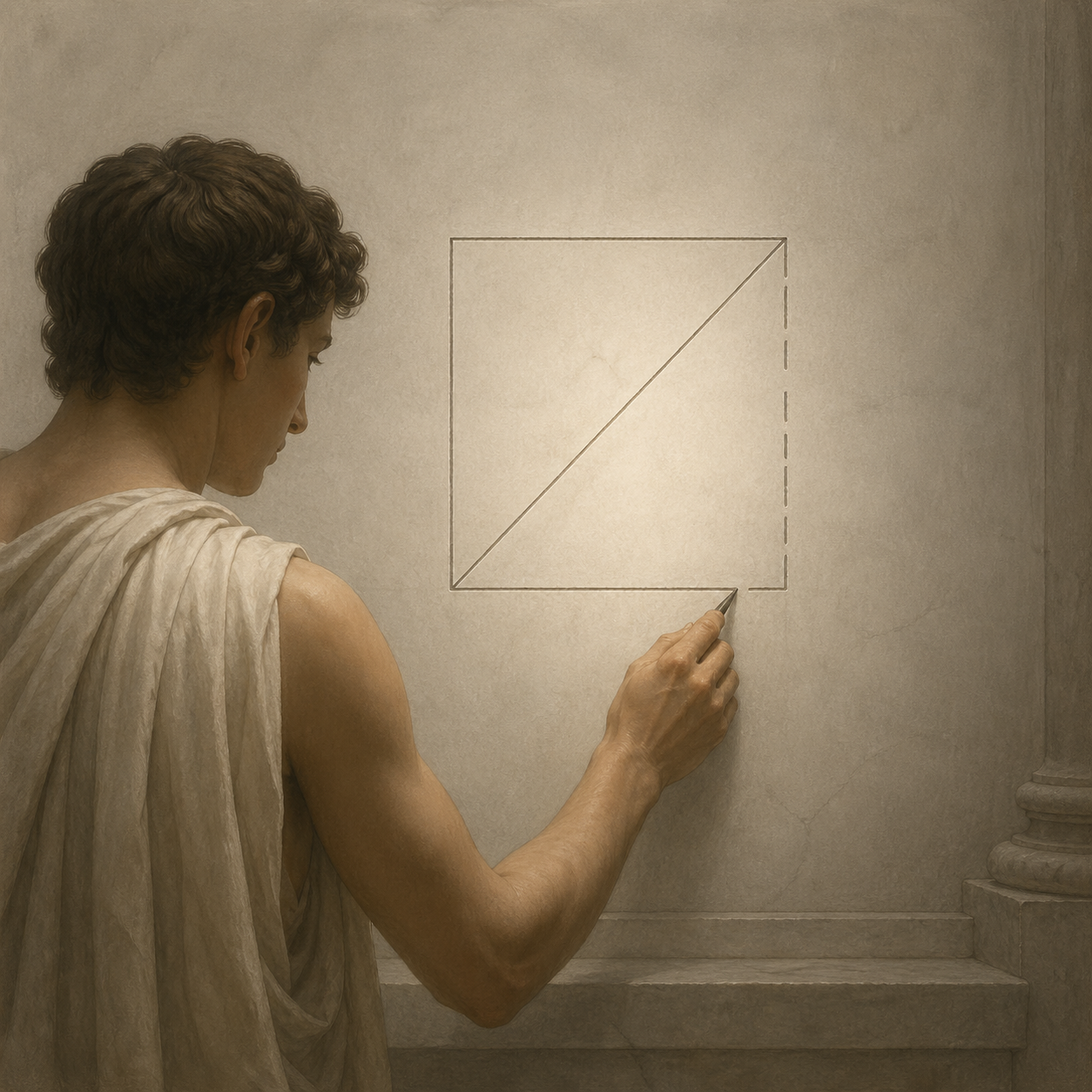
To show that the theory of recollection is not merely a convenient myth, Socrates asks Meno's slave boy — a person with no mathematical education — to work through a geometry problem: how to construct a square with double the area of a given square. Through a series of questions that put no information into the boy but only draw out responses, Socrates guides him to the correct answer. At no point does Socrates tell the boy anything; he only asks questions. The boy corrects his own mistakes through his own reasoning.
What the Demonstration Shows
Socrates takes the demonstration to show that the boy had the knowledge already — not from his current life but from a prior existence. The questioning process didn't create knowledge but merely made explicit what was implicit. The boy's ability to correct himself when he reaches contradictions shows that he has some internal standard by which he can evaluate proposed answers — and that standard cannot have come from the current conversation, since Socrates has not provided it.
The Distinction from Teaching
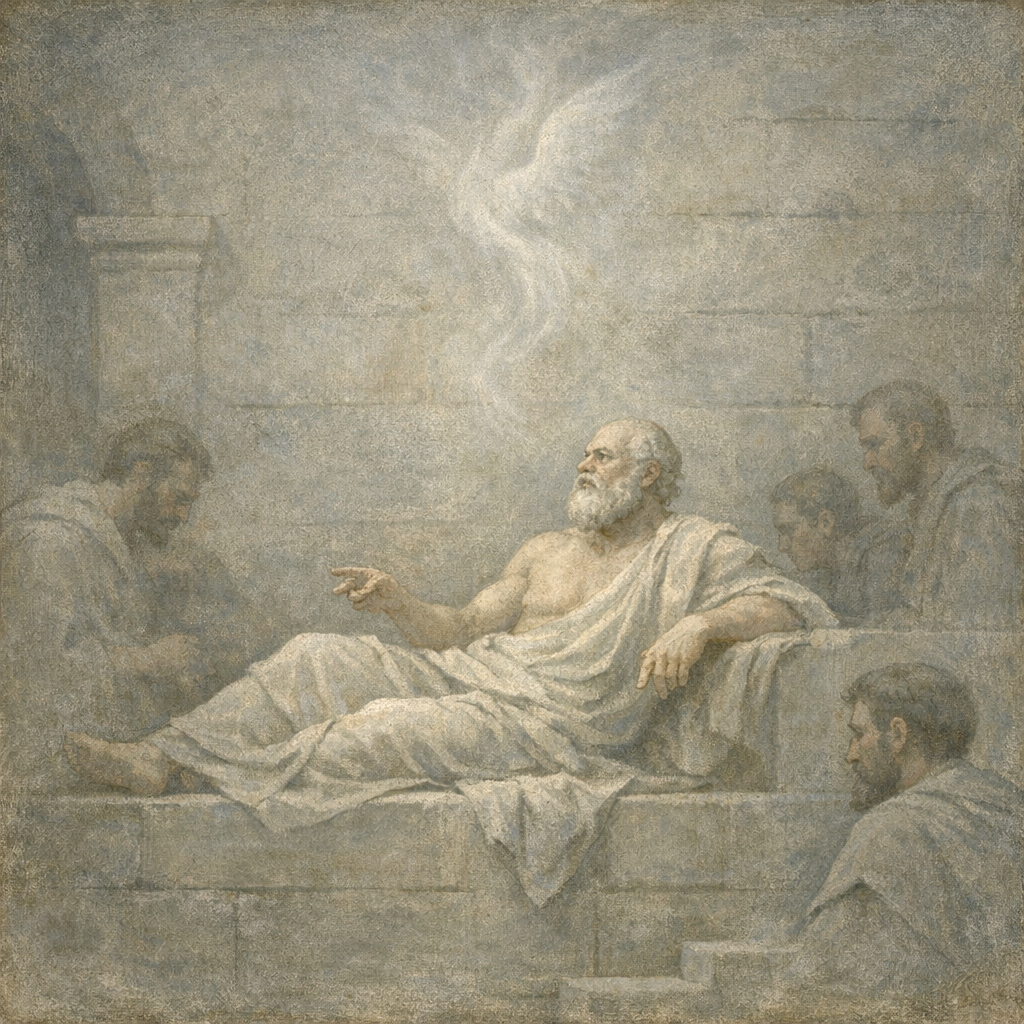
The recollection theory changes what good teaching is. A teacher who simply transfers information — pouring knowledge into a passive vessel — is not engaged in genuine education. The midwifery metaphor of the Theaetetus is relevant here: Socrates describes himself not as one who transmits knowledge but as a midwife who helps others give birth to knowledge they already carry. Good teaching is the art of asking the right questions at the right time in the right order to help the learner recall what they need.
The Limits of the Theory
The demonstration is philosophically loaded in ways that have been noticed since antiquity. Socrates asks questions that are leading — that presuppose certain conceptual frameworks — and the slave boy's geometry problem involves spatial intuitions that may be culturally or biologically grounded rather than evidence of prenatal knowledge. Aristotle rejected the whole theory, arguing that the soul does not pre-exist the body and that all knowledge begins in sensory experience. The debate between rationalists (who find Plato compelling) and empiricists (who follow Aristotle) has structured epistemology ever since.
The slave boy demonstration occupies Meno 82b–85b. It is often regarded as the first rigorous attempt in Western philosophy to show that some knowledge is a priori — independent of sensory experience. The specific geometry problem — doubling the square — requires recognising that the diagonal of a square is incommensurable with its side, a fact that cannot be derived from ordinary perceptual experience.
Related Concepts