The Overflow of Perfection
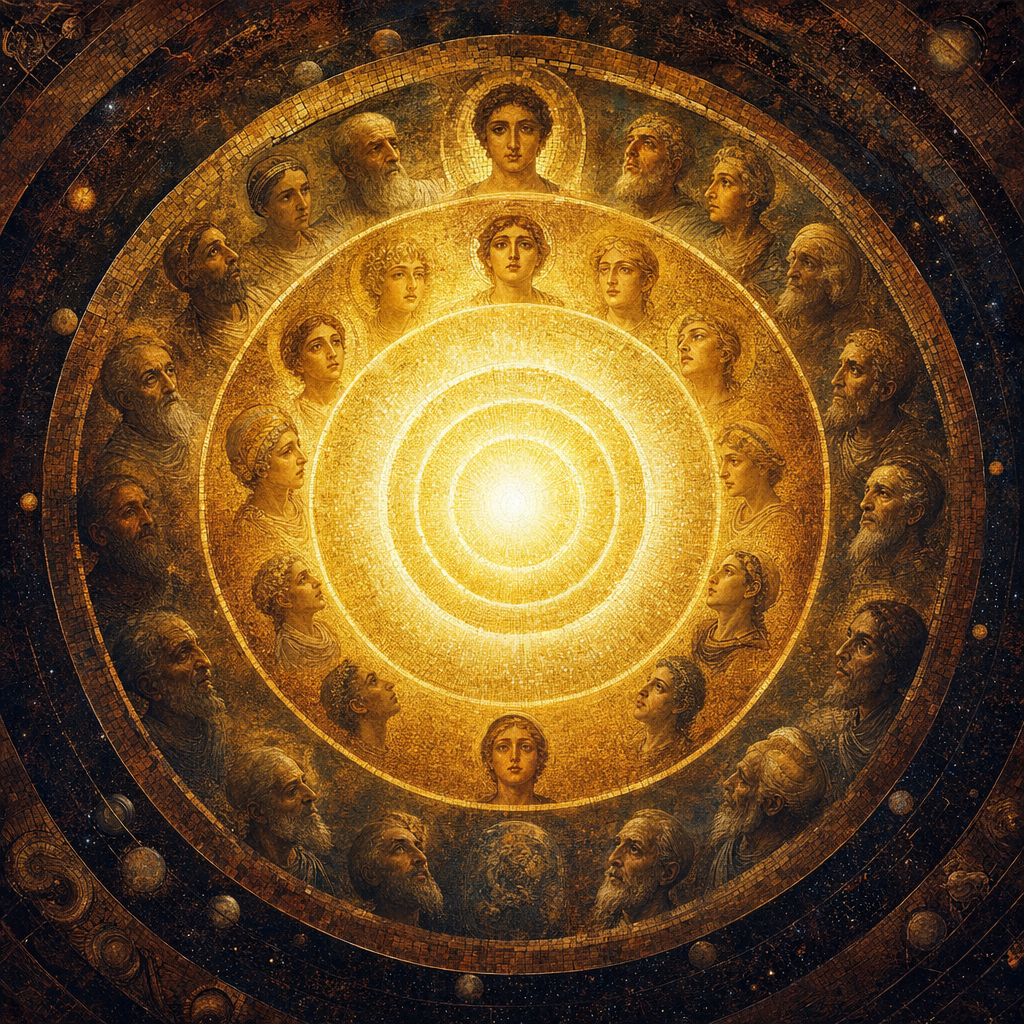
Plotinus uses a cluster of metaphors to describe emanation: the sun and its light, the spring and its water, the fragrance that a flower diffuses without losing anything of itself. What these images have in common is that the source remains unchanged — the One does not diminish by producing Intellect, nor does Intellect diminish by producing Soul. Emanation is not division but radiation. The lower proceeds from the higher not by extraction but by a kind of necessary generosity: to be utterly perfect is to give rise to what is less than perfect, simply by being what one is.
Procession and Reversion
Emanation is not merely a one-way cascade. At each level, what proceeds from its source also turns back toward it — a movement Plotinus calls "reversion" (epistrophê). Intellect proceeds from the One and, in turning to contemplate the One, becomes determinate: it is the act of this contemplation that generates the Forms, the rich multiplicity of intelligible archetypes that Intellect contains. Soul proceeds from Intellect and, in reverting toward Intellect, receives the intelligible life that it then mediates to the world below. Everything that proceeds longs for its source; this longing is the engine of all movement in the Plotinian cosmos.
Matter and Evil
Emanation eventually reaches a limit: matter, the furthest terminus of the procession, the point at which being has so thinned that it is barely there at all. Matter for Plotinus is not evil in itself — it is simply the privation of Form, the darkness that results when the light of the One has travelled as far as it can. Evil, correspondingly, is not a positive force but an absence: the failure of matter to receive Form fully. This means that the cosmos, despite its distance from the One, is not corrupt or hostile. It is the best possible world — the fullest expression of the One's overflowing nature compatible with the existence of levels below the highest.
The metaphors of the sun, the spring, and fragrance appear throughout the Enneads, especially in V.1, V.2, and III.8. The relationship between emanation and creation ex nihilo has been debated by scholars of Plotinus, Proclus, and Christian Neoplatonism since antiquity.
Related Concepts