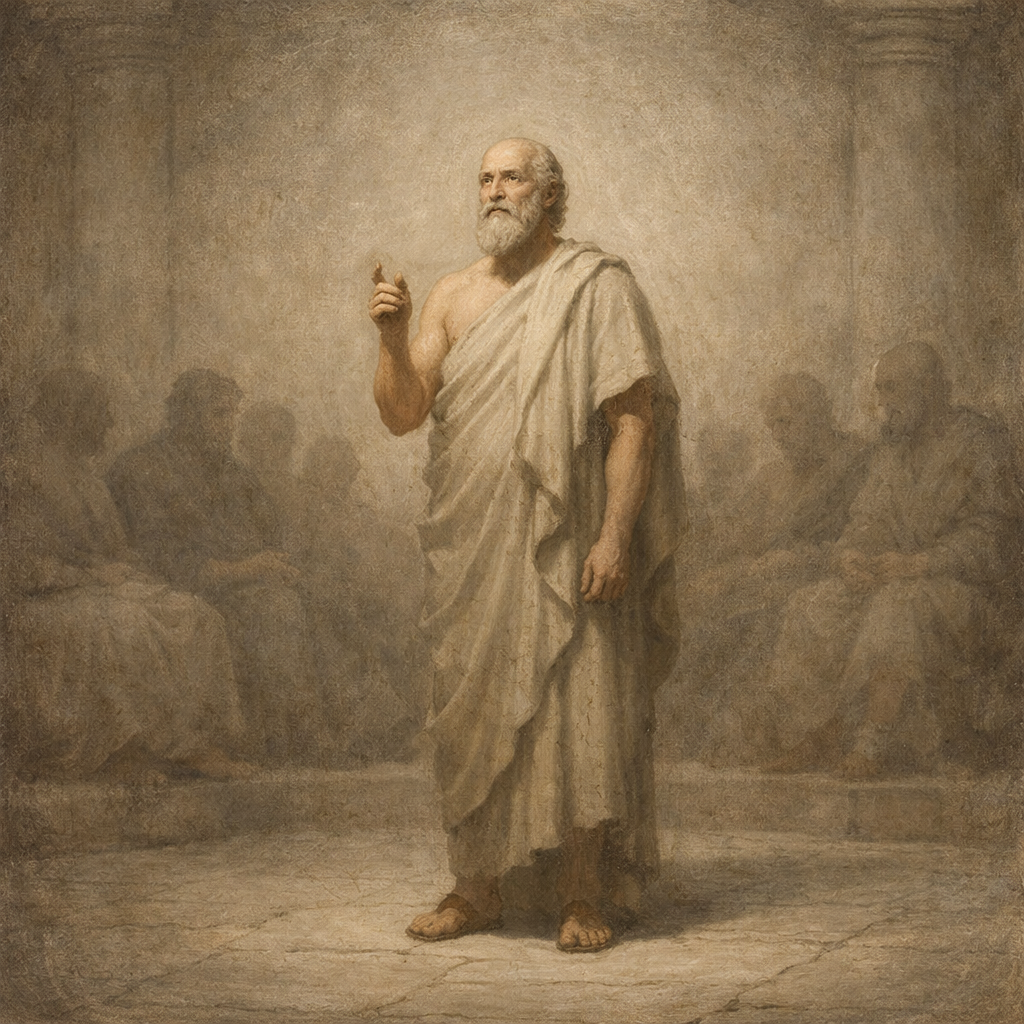
The Oracle and the Investigation
When Chaerephon received the oracle's answer — that no man was wiser than Socrates — Socrates was convinced there had been a mistake. His response was methodical: he set out to find people wiser than himself in order to refute the oracle. What he found instead, across years of inquiry into politicians, poets, and craftsmen, was that none of them possessed the wisdom they believed they had. The investigation that began as an attempt to disprove the oracle ended by confirming it — and transforming it into a mission.
Chaerephon, as you know, was very impetuous in all his doings, and he went to Delphi and boldly asked the oracle to tell him whether anyone was wiser than I was, and the Pythian prophetess answered, that there was no man wiser.
Obedience to God Over Men
The mission required Socrates to be poor, unpopular, and ultimately prosecuted. He does not pretend otherwise. But he insists that abandoning it would be a greater evil than whatever the Athenian jury could inflict. His famous declaration — that he will obey God rather than the jury — is not the expression of a religious fanatic but the consequence of his argument. If the unexamined life is not worth living, and if his mission of philosophical examination is divinely ordained, then to abandon it in exchange for survival would be to accept a life not worth living.
while I have life and strength I shall never cease from the practice and teaching of philosophy
A Public Good Disguised as a Nuisance
Socrates frames his mission as a service to Athens, not a private pursuit. He does nothing for himself: he is poor, he ignores his own affairs, he has no disciples who pay him fees. What he does is go about the city confronting people who believe they possess wisdom they do not have — exposing the gap between reputation and reality, between appearance and knowledge. This service is uncomfortable and makes enemies. But Socrates insists it is the greatest good the city has received, and the god who sent him would not permit him to stop.
The account of the divine mission runs through Chapter 1 of the Apology. The concept of a philosopher called to a specific task by divine command sits oddly with Socrates's usual insistence that he has no teaching and no wisdom. This tension — between the humility of Socratic ignorance and the confidence of divine appointment — is one of the most productive paradoxes in the Platonic corpus.
Related Concepts