The Self as a Relation
Anti-Climacus begins with a definition that sounds abstract until its stakes are felt: a human being is a synthesis of the finite and the infinite, the temporal and the eternal, freedom and necessity. But a synthesis must be held together by something. The self is not the synthesis itself but the relating of the synthesis to itself — and this relating must in turn be grounded in the power that established it, which is God. Despair is the failure of this relation: the self out of relation with itself, or the self out of relation with the power that established it, or both.
Defiant and Weak Despair
Anti-Climacus distinguishes two fundamental modes of despair. The despair of weakness (not willing to be oneself) is the more common: the self flees from itself, refuses to acknowledge what it is, hides in the distractions of the finite. The despair of defiance (willing to be oneself on one's own terms) is rarer and in some ways more terrifying: the self refuses to be what God intends it to be and insists on constructing itself from its own resources. Both are forms of the same fundamental disease: the self not resting in the power that established it. Neither is more painful than the other; the defiant despairer may feel not distress but a fierce and isolated pride.
The Fortunate Life of the Unconscious Despairer
The most diagnostically acute part of Anti-Climacus's analysis is his portrait of the person who is in despair without knowing it. Such a person may, by every external measure, have a wonderful life: health, wealth, family, achievement, social recognition. They feel no particular suffering. But their life is not grounded in the power that established them; it is built entirely on the finite, and the finite will fail. The apparent contentment of the unconscious despairer is, for Anti-Climacus, the deepest form of despair: not only is the self sick, but it is unable to recognise its own sickness. Kierkegaard diagnoses the modern world as overwhelmingly populated by such persons.
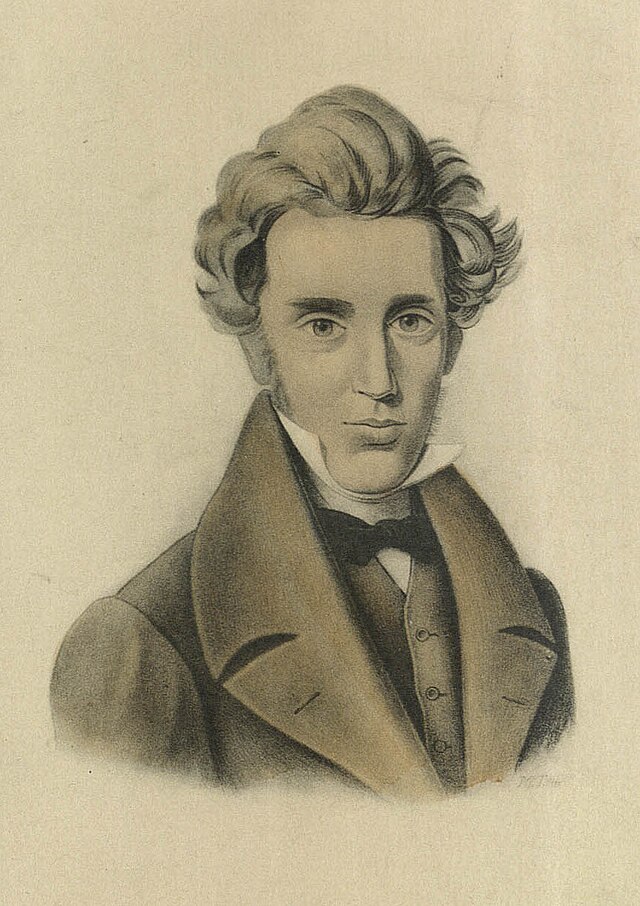
The Sickness Unto Death (1849) was published under the pseudonym Anti-Climacus, a figure of higher Christian consciousness than Kierkegaard claimed for himself. The title echoes John 11:4, where Jesus says of Lazarus's illness that "this sickness is not unto death" — the paradox being that the sickness Kierkegaard analyses is precisely unto death in the sense of being fatal to genuine selfhood.
Related Concepts