The Dizziness of Freedom
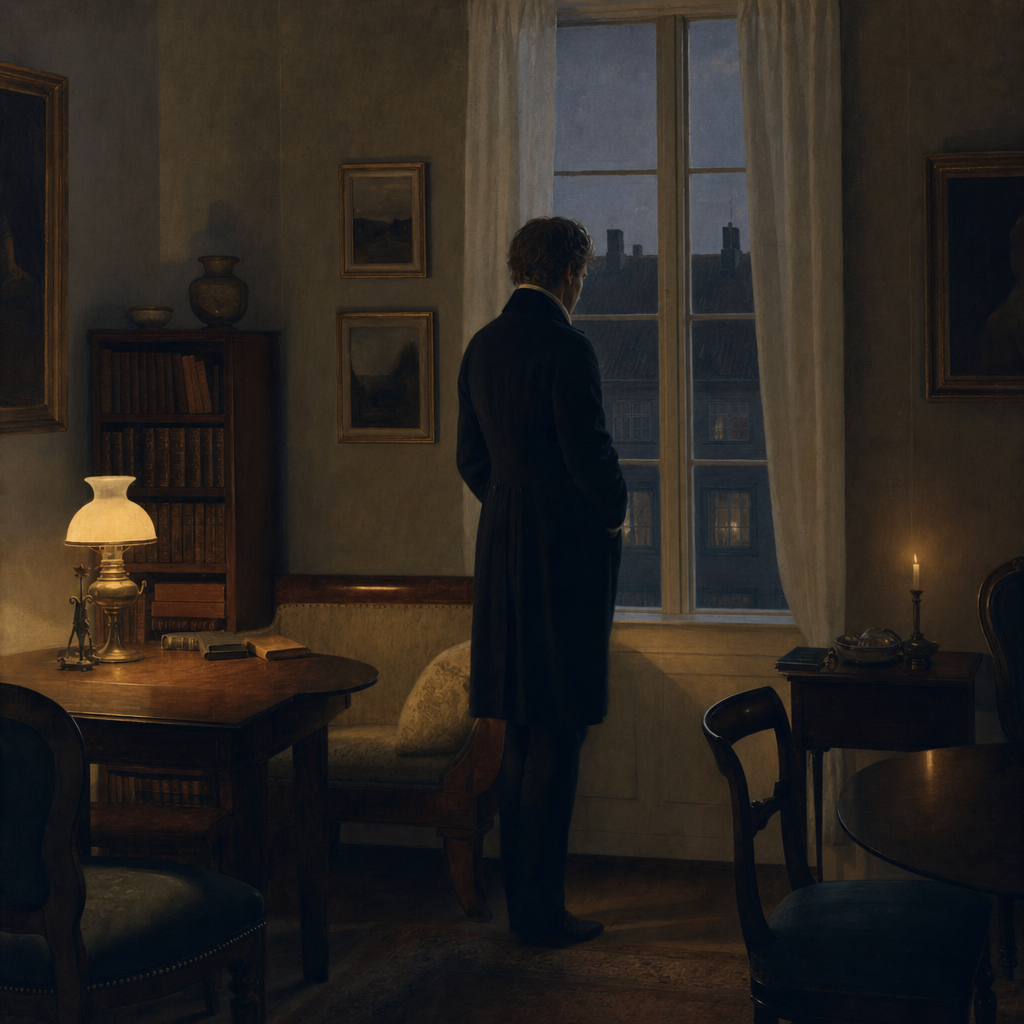
Kierkegaard's famous image is of a person standing at the edge of a cliff. They feel dizzy — but not because the drop threatens to take them. They feel dizzy because they are aware that they could throw themselves off. Nothing prevents it; no external force secures them against the possibility of their own freedom. Anxiety is this dizziness: the awareness of possibility as such, not of any particular threatening possibility. The person gripped by anxiety is not afraid of something but of the openness that their freedom constitutes. They are, as Kierkegaard says, made dizzy by their own freedom.
Anxiety and Possibility
Anxiety differs from fear in its object: fear has an object (the dog, the dark, the fall), while anxiety has no object or has possibility itself as its object. The spirit, on the threshold of self-realisation, looks out at its own possibilities and experiences their openness as both attractive and terrifying. This double quality — the anxious allure of what one might become — is what Kierkegaard means when he speaks of anxiety as "a sympathetic antipathy and an antipathetic sympathy": one is drawn toward what one dreads, repelled by what one desires. This ambivalence is not a malfunction but the accurate emotional register of genuine freedom.
Anxiety as the School of Faith
Crucially, Kierkegaard does not recommend the elimination of anxiety. The person who feels no anxiety is not free; they have simply not yet encountered the full depth of their own possibility. Anxiety is the school through which the spirit must pass — the educating experience that, if endured rather than evaded, opens the self to genuine existence. The one who has been truly schooled by anxiety knows, at the deepest level, that they could have been otherwise, that every choice carries infinite weight, that existence is not something that happens to one but something one takes on. This knowledge is the prerequisite of faith.
The Concept of Anxiety (1844) was published pseudonymously by Vigilius Haufniensis. The concept of anxiety as the dizziness of freedom appears in §1 of Chapter I and is developed throughout the work. The book's influence on Heidegger's analysis of anxiety in Being and Time (1927) is acknowledged by Heidegger himself.
Related Concepts