Necessity as a Costume for Absurdity
Pangloss does not merely assert that things are good — he claims they are logically necessary. Noses exist to hold spectacles, legs to wear stockings, the earth to produce food. Every feature of the world points to a divine purpose that makes it the best conceivable arrangement. This doctrine, carried to its conclusion, means that nothing could ever be improved, that every evil is secretly a necessity, and that suffering is simply evidence of a pattern too large for ordinary minds to see.
"It is demonstrable," said he, "that things cannot be otherwise than as they are; for all being created for an end, all is necessarily for the best end. Observe, that the nose has been formed to bear spectacles—thus we have spectacles. Legs are visibly designed for stockings—and we have stockings. Stones were made to be hewn, and to construct castles—therefore my lord has a magnificent castle; for the greatest baron in the province ought to be the best lodged. Pigs were made to be eaten—therefore we eat pork all the year round. Consequently they who assert that all is well have said a foolish thing, they should have said all is for the best."
The Satire of Leibniz
Voltaire targets Gottfried Wilhelm Leibniz, whose Theodicy (1710) argued that God, being perfect, could only have created the best possible world — and that apparent evils are either necessary for a greater good or illusory from our limited perspective. Pangloss is a portrait of this philosophy taken to its logical extreme, where the argument from necessity becomes a refusal to acknowledge that anything is genuinely wrong. The comedy, and the horror, lies in Pangloss maintaining this position through plague, shipwreck, earthquake, flogging, and hanging.
Philosophy as Blinder
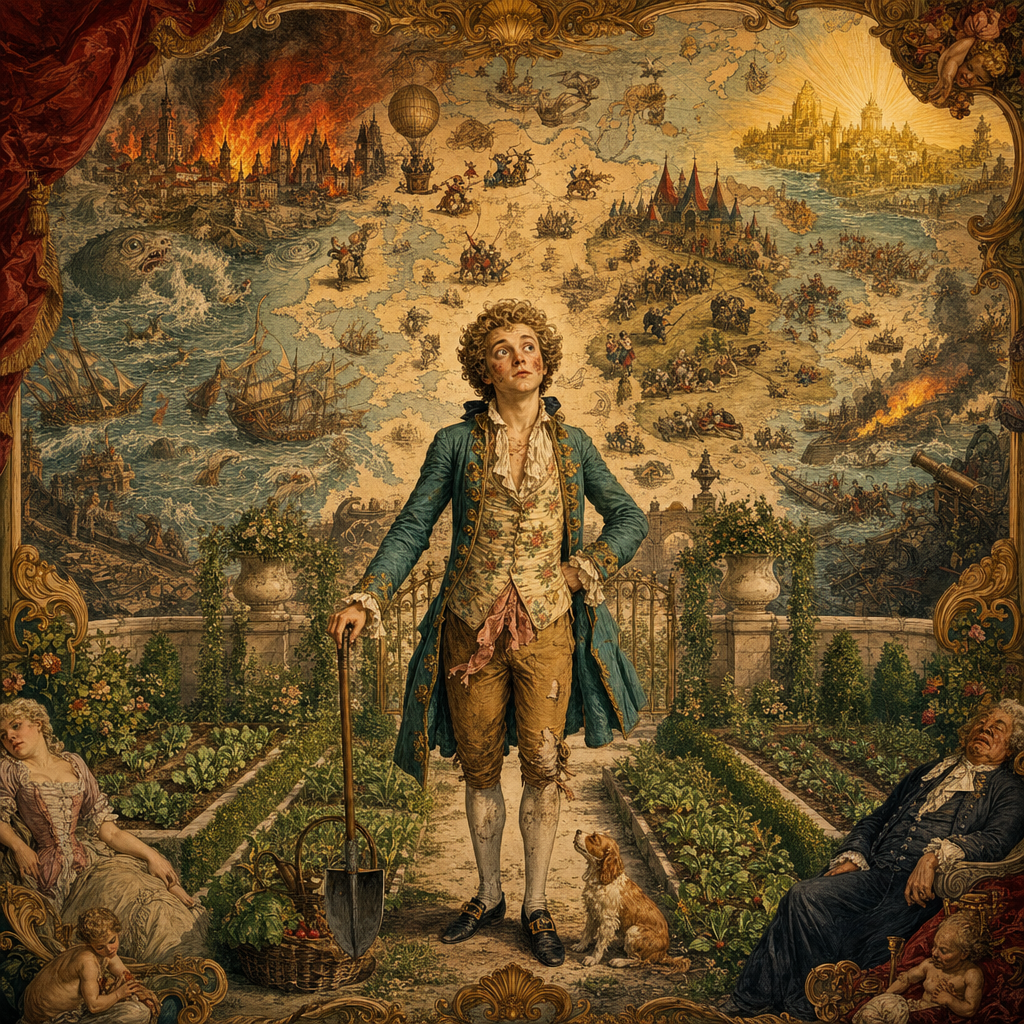
The deepest critique in Candide is not that optimism is false, but that it is paralysing. When Pangloss watches his benefactor drown, he stops Candide from jumping to save him on philosophical grounds. When Lisbon burns, he searches for a sufficient reason. Optimism, in Voltaire's hands, is not comfort — it is the intellectual alibi of those who prefer theory to suffering humanity. The "best of all possible worlds" is most dangerous not as metaphysics but as a reason not to act.
The doctrine of Pangloss parodies Leibniz's Theodicy (1710) and Pope's Essay on Man (1733). Voltaire wrote Candide in 1759, partly in response to the Lisbon earthquake of 1755, which killed tens of thousands and shook European confidence in providential optimism.
Related Concepts