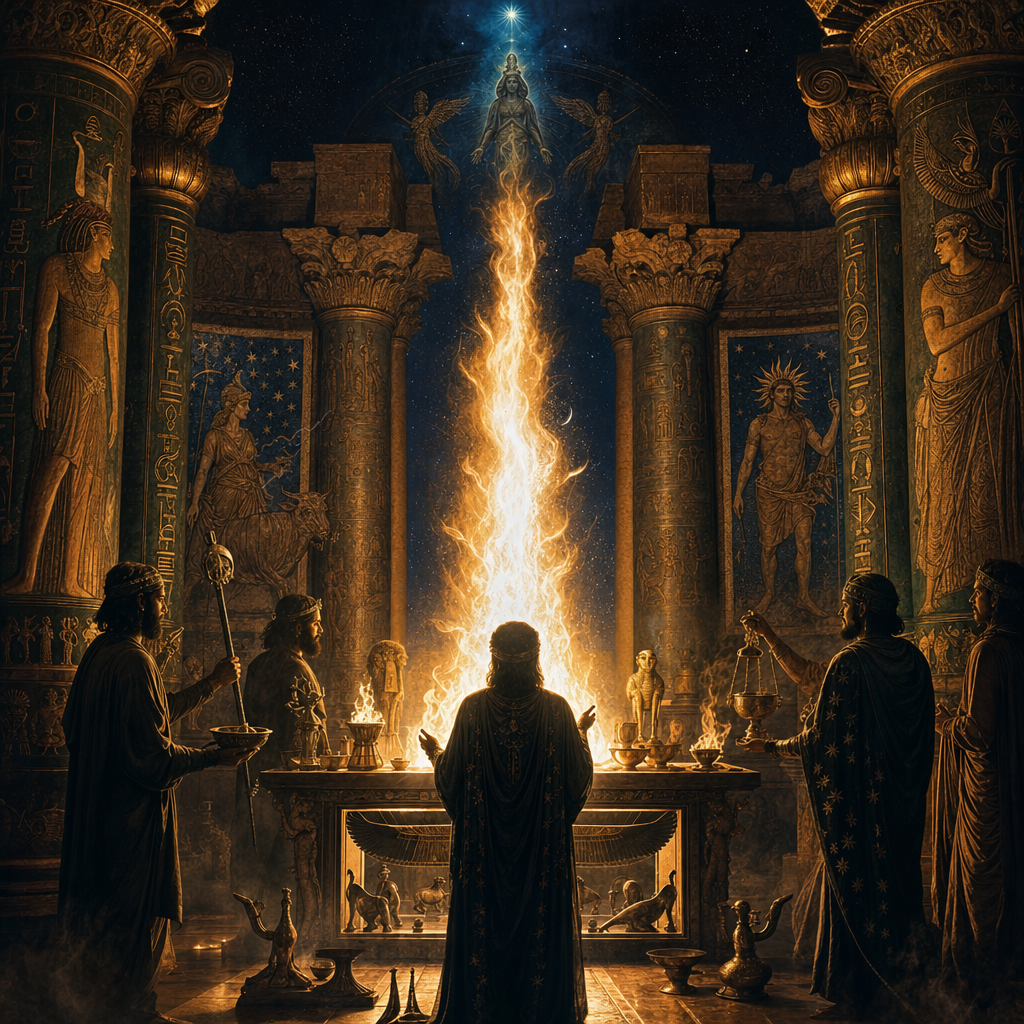
De Mysteriis — formally a reply to the philosopher Porphyry's letter to the Egyptian priest Anebo — is the most important document of late antique theurgy and one of the strangest works in the history of philosophy. Written in the persona of the Egyptian sage Abammon, Iamblichus defends the practice of theurgy (divine ritual operations: sacrifices, hymns, sacred names, sympathetic objects, oracles) against Porphyry's Plotinian view that the soul can ascend to the divine by philosophical contemplation alone. For Iamblichus, the soul is too deeply embedded in matter and multiplicity to raise itself by its own intellectual efforts: what is needed is the gods themselves reaching down through a network of ritual connections — symbols, sacrifices, sacred fires — to pull the soul upward. The treatise systematically describes the hierarchy of divine beings (gods, archangels, angels, daimones, heroes, material daimones, souls) and explains the proper way to approach each level. De Mysteriis shaped the later Neoplatonism of Proclus and had a profound influence on Renaissance Hermeticism and Ficino's Platonic Academy.
This work isn't available here yet. In the meantime you can purchase a copy on Amazon, or check back later, as we are always adding books to our library.
As an Amazon Associate we earn from qualifying purchases.