The Buddha's Anti-Caste Institution
Ambedkar emphasises the radical social character of the original Sangha: the Buddha admitted members from all castes and both sexes, required the abandonment of caste distinctions on entry, and organised the community on principles of equality, consent, and collective decision-making. The Vinaya (the rules governing monastic life) is notably democratic in its procedures for resolving disputes and making collective decisions — a constitutionalism embedded in religious practice fifteen hundred years before European political theory developed comparable ideas.
Community Against Hierarchy
For Ambedkar, the Sangha is not primarily a spiritual community but a social one: a space in which the hierarchies of birth and occupation are suspended and replaced by hierarchies of practice and seniority in the Dhamma alone. To enter the Sangha is to enact a different social order — not to wait for it to arrive but to inhabit it here and now. This is what makes conversion a political act: the Dalit who converts to Buddhism is not merely changing her metaphysical beliefs but changing her social identity and her social relationships.
The Sangha Today
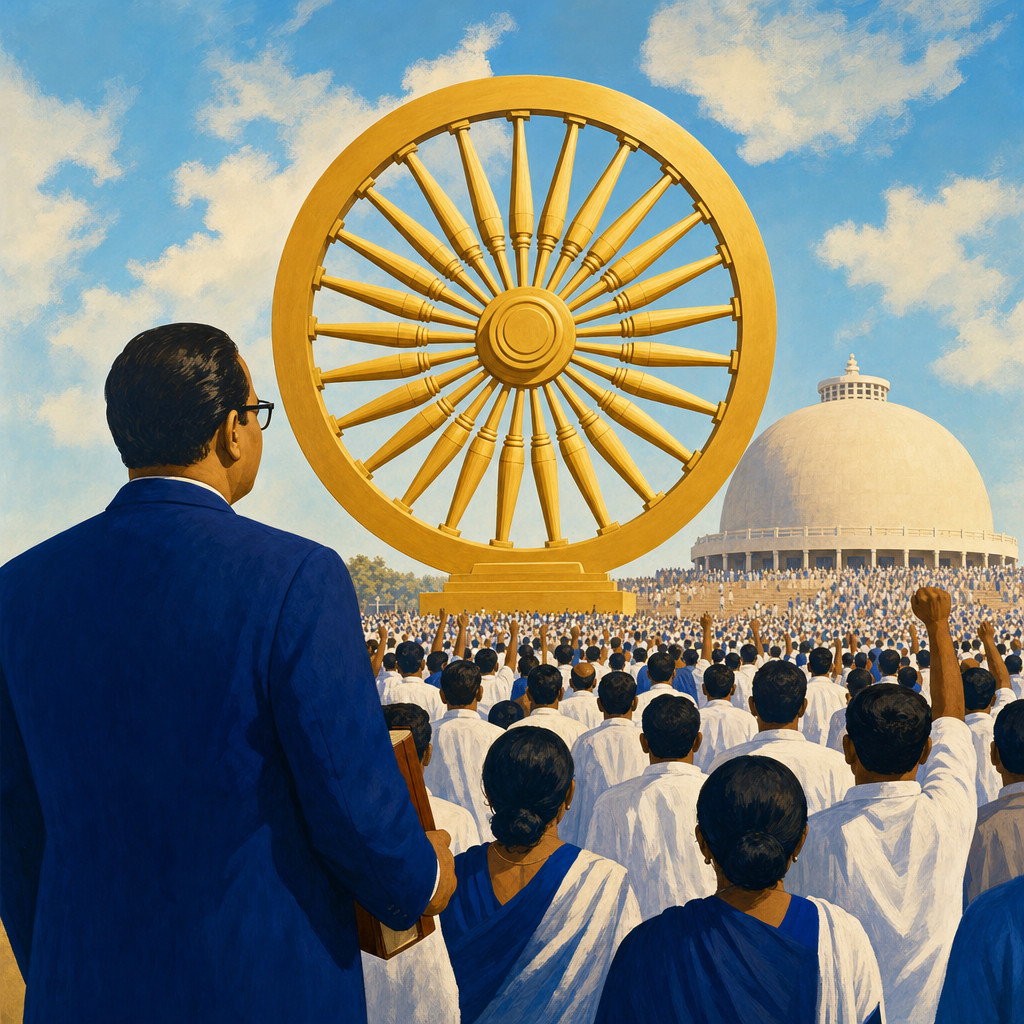
Ambedkar's vision of the Sangha has had enormous practical consequences. The Dalit Buddhist movement in Maharashtra — now numbering in the millions — has developed a network of educational, social, and political institutions explicitly modelled on Ambedkar's interpretation of the Sangha as a counter-institution to caste society. The community that gathered on the Deekshabhoomi in Nagpur on 14 October 1956 was not merely converting but founding a new social world.
Ambedkar's interpretation of the Sangha as a democratic institution is developed in The Buddha and His Dhamma (1956) and in his earlier essay "The Rise and Fall of the Hindu Women" (1950). The Deekshabhoomi conversion ceremony is commemorated annually as Dhammachakra Pravartan Din.
Related Concepts