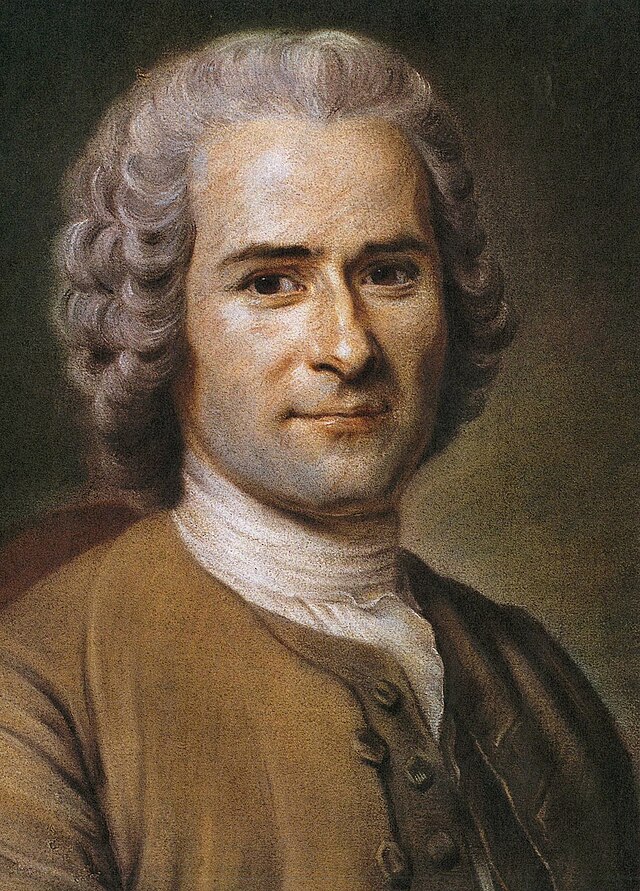
Not History, But Hypothesis
Rousseau is explicit that his state of nature is not a historical claim. He is not arguing that human beings once lived in pristine isolation and then fell into civilisation. His aim is philosophical: to strip away all the acquired characteristics of social life — language, reason, property, morality — and ask what a human being would be like if all these accretions were removed. The result is a thought experiment designed to reveal which inequalities are natural and which are artificial.
O man, of whatever country you are, and whatever your opinions may be, behold your history, such as I have thought to read it, not in books written by your fellow-creatures, who are liars, but in nature, which never lies.
Against Hobbes
The Hobbesian natural man is aggressive, competitive, and in permanent fear of death — a social atom whose natural condition is war of all against all. Rousseau inverts this picture. Natural man has simple needs that the environment easily satisfies. He does not desire what others have because he does not yet think in terms of comparison. He is not compassionate in the modern sense, but he is not cruel either: cruelty requires the imagination to take pleasure in another's suffering, which natural man lacks.
Freedom as the Defining Feature
What distinguishes man from animal in the state of nature is not reason — many animals are rational in a limited sense — but the capacity for self-perfection: the ability to change, to learn, and to choose. This perfectibility is also humanity's curse: it is what makes social development possible, and social development is the source of inequality, vanity, and misery. Natural man is free precisely because he has not yet exercised this capacity.
The state of nature is reconstructed in Part I of the Discourse on the Origin of Inequality (1755). G.D.H. Cole translation, 1913.
Related Concepts