Enlightenment as Domination
For Horkheimer and Adorno, Enlightenment is not primarily a set of doctrines but a practice: the project of mastering nature through knowledge, of making the world calculable, predictable, and controllable. This practice is as old as myth itself — myth also tried to master the unknown through naming and ritual — but Enlightenment extends it further and more systematically, eliminating the residues of qualitative difference that myth still preserved. The mathematical formalisation of nature strips the world of meaning, leaving only quantity, measurable and manipulable.
Odysseus and the Archetype of Bourgeois Reason
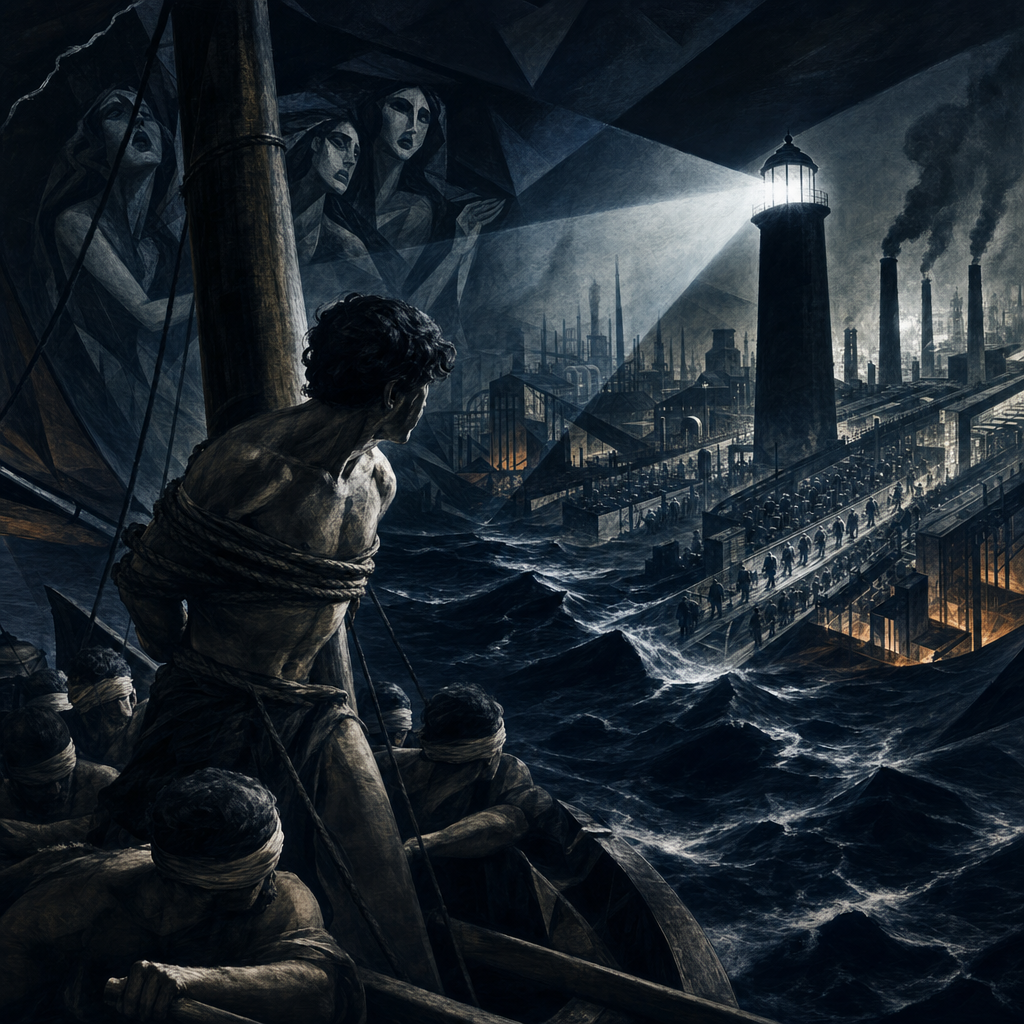
The Odyssey becomes, in their reading, the ur-text of Enlightenment reason. Odysseus escapes the mythic forces that threaten him — the Sirens, Circe, Polyphemus — not by superior strength but by cunning: renouncing direct enjoyment, disciplining his impulses, subordinating desire to the end of self-preservation. This renunciation is the prototype of the bourgeois self — the calculating ego that masters the world by mastering itself, at the cost of the very life it sought to preserve. The ruse of the self-mastering subject is already present in Homer.
The Dialectic
The dialectic is this: the tools developed to overcome myth — universal concepts, the subsumption of particulars under laws, the elimination of the qualitatively different — themselves become a new form of domination. Enlightenment, in achieving its aim of mastering nature, produces a second nature: the administered society, the culture industry, the bureaucratic state — systems as opaque and coercive as any ancient fate. Myth is already enlightenment because it too was a practice of domination through classification; enlightenment reverts to mythology because its own drive to totality repeats the mythic closure it claimed to overcome.
The dialectic of myth and enlightenment is the subject of the "Concept of Enlightenment" chapter and the "Excursus I: Odysseus, or Myth and Enlightenment" in Dialectic of Enlightenment (1944). The analysis draws on Weber's concept of rationalisation as disenchantment.
Related Concepts