Identity Thinking and Its Violence
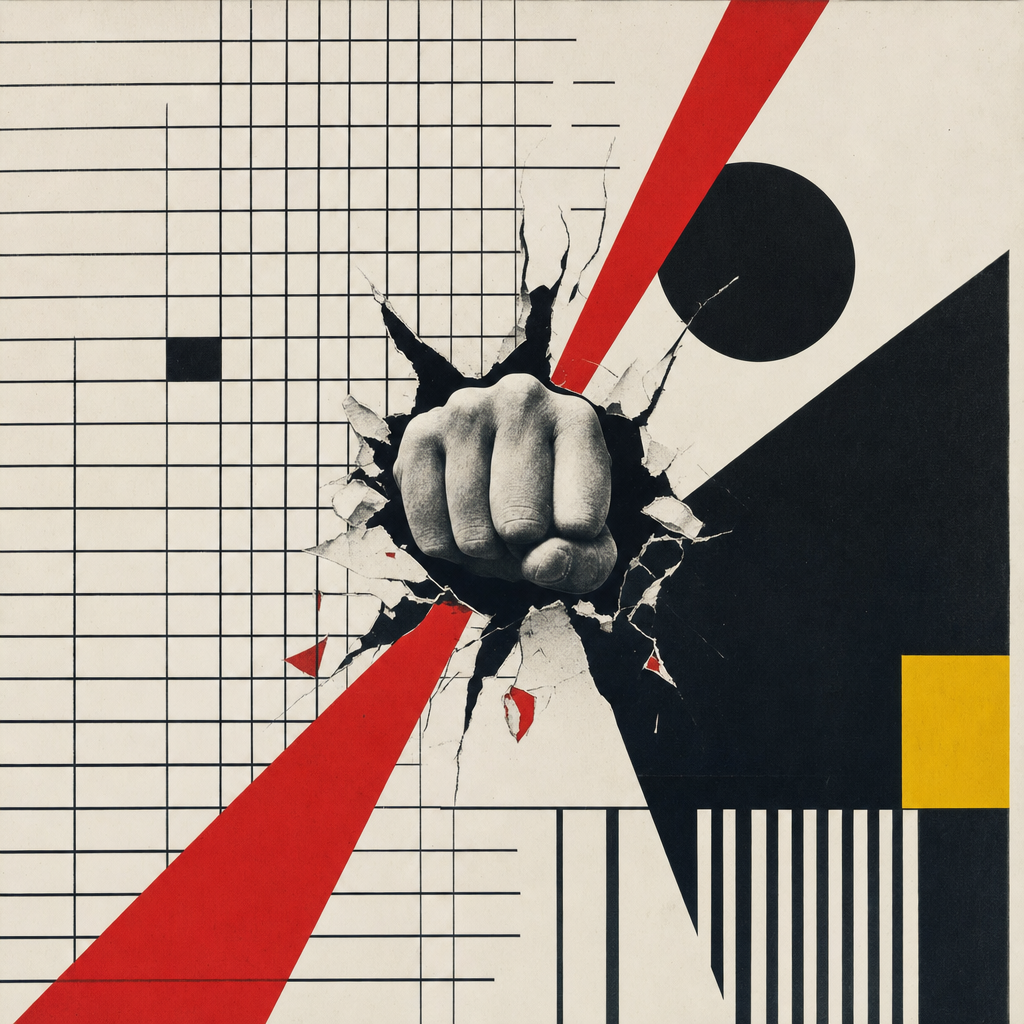
Identity thinking is the logic of the concept: every concept identifies its object by subsuming it under a general category, treating it as an instance of a type. This is not merely an epistemological error but a reflection of social reality under capitalism, where everything is reduced to exchange value — its quantitative equivalence to everything else. The violence of the concept mirrors the violence of exchange: both eliminate qualitative difference in favour of abstract equivalence. Negative dialectics begins from the recognition that no concept fully captures its object, that there is always a remainder — the non-identical — that thought must acknowledge rather than suppress.
Against Hegel
Adorno's critique is directed most sharply at Hegel, whose dialectics promised to do justice to contradiction and particularity but in fact resolved everything into the self-movement of the Concept. Hegelian synthesis is the supreme act of identity thinking: the contradiction between thesis and antithesis is aufgehoben — negated, preserved, elevated — into a unity that contains them both. Adorno reads this as a philosophical cover for domination: the particularity that was supposed to be preserved in the synthesis is in fact absorbed into the universal without remainder. Negative dialectics refuses the synthesis.
The Task of Philosophy
For Adorno, philosophy's task is not to build systems that cover the whole of reality but to use concepts against themselves — to push concepts to their limit until the non-identical that they exclude becomes visible. This is a form of immanent critique: philosophy works with the concepts it inherits rather than claiming a standpoint outside them, but uses them against the grain, attending to their failure to capture their objects as an index of what remains to be thought. The result is not a new positive doctrine but a mode of attention — a way of staying with the particular that resists the comfort of premature resolution.
Negative Dialectics (1966) is the systematic centre of Adorno's mature philosophy, though it deliberately resists system. The opening sentence — "Philosophy, which once seemed obsolete, lives on because the moment to realise it was missed" — is one of the most discussed sentences in twentieth-century philosophy.
Related Concepts