The Presuppositionless Beginning
The Science of Logic must begin without presuppositions — without importing any content from outside philosophy. The only legitimate starting point is therefore the most abstract thought conceivable: pure Being, with no further determination. But pure Being, with nothing said about it, with no quality or content whatsoever, is indistinguishable from Nothing. Both are completely empty; the attempt to think one immediately slides into the other. This is not a paradox to be resolved but the first movement of the Logic.
Becoming as the First Concrete Category
Being vanishes into Nothing; Nothing vanishes into Being. The truth of both is their movement into each other — and this movement is Becoming. Becoming is the first category that has genuine content: it contains Being and Nothing as moments (they are aufgehoben within it) and adds the dynamic of transition between them. Coming-to-be is Nothing transitioning into Being; ceasing-to-be is Being transitioning into Nothing. The universe begins not with a static given but with this restless mutual vanishing.
Why It Matters
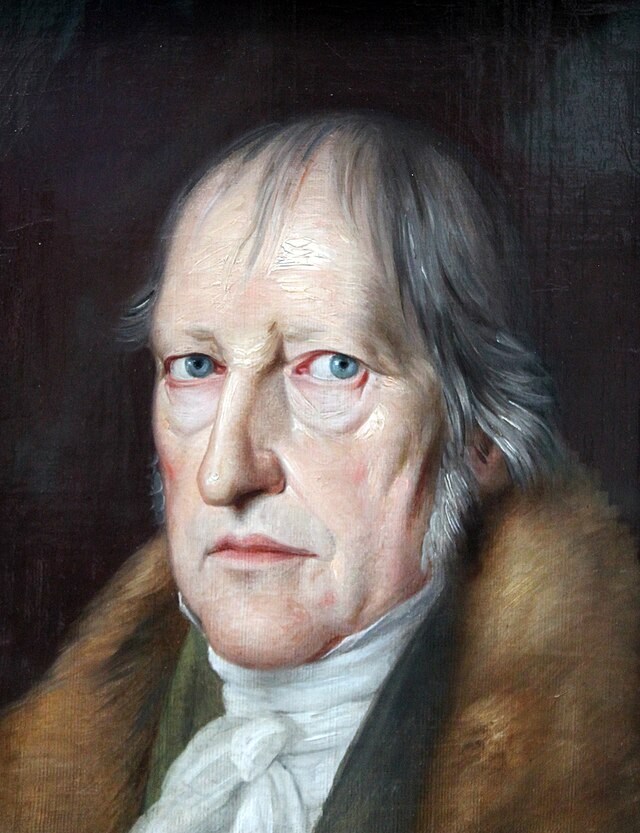
The opening triad is not merely a clever logical puzzle. It establishes the method that will govern the entire Logic: every category, when thought rigorously, generates its own opposite and is resolved in a higher unity. The Logic is not an external classification of pre-given concepts but a self-moving development in which thought discovers its own necessity. Hegel's claim is that this logical development is also the structure of reality itself — that the universe is, at its deepest level, this self-moving conceptual process.
The Idealist Claim
The identification of logical and ontological structure is Hegel's most ambitious and most contested move. He is not saying that the physical universe is made of thoughts. He is saying that the categories by which we understand Being — the most fundamental structures of what it means to be something rather than nothing — are the same categories that thought discovers when it thinks itself rigorously. Logic and metaphysics are one. This is Hegel's answer to Kant's restriction of knowledge to the phenomenal realm.
The opening of the Science of Logic has been the subject of an enormous secondary literature. G. E. Moore's famous rejection of Hegelian idealism in the early twentieth century targeted precisely this kind of claim. More sympathetic readings by Robert Pippin and Robert Brandom argue that Hegel's Logic is best understood as a theory of the conceptual conditions of objective knowledge rather than a claim about cosmic stuff.
Related Concepts