A Motto for the Whole System
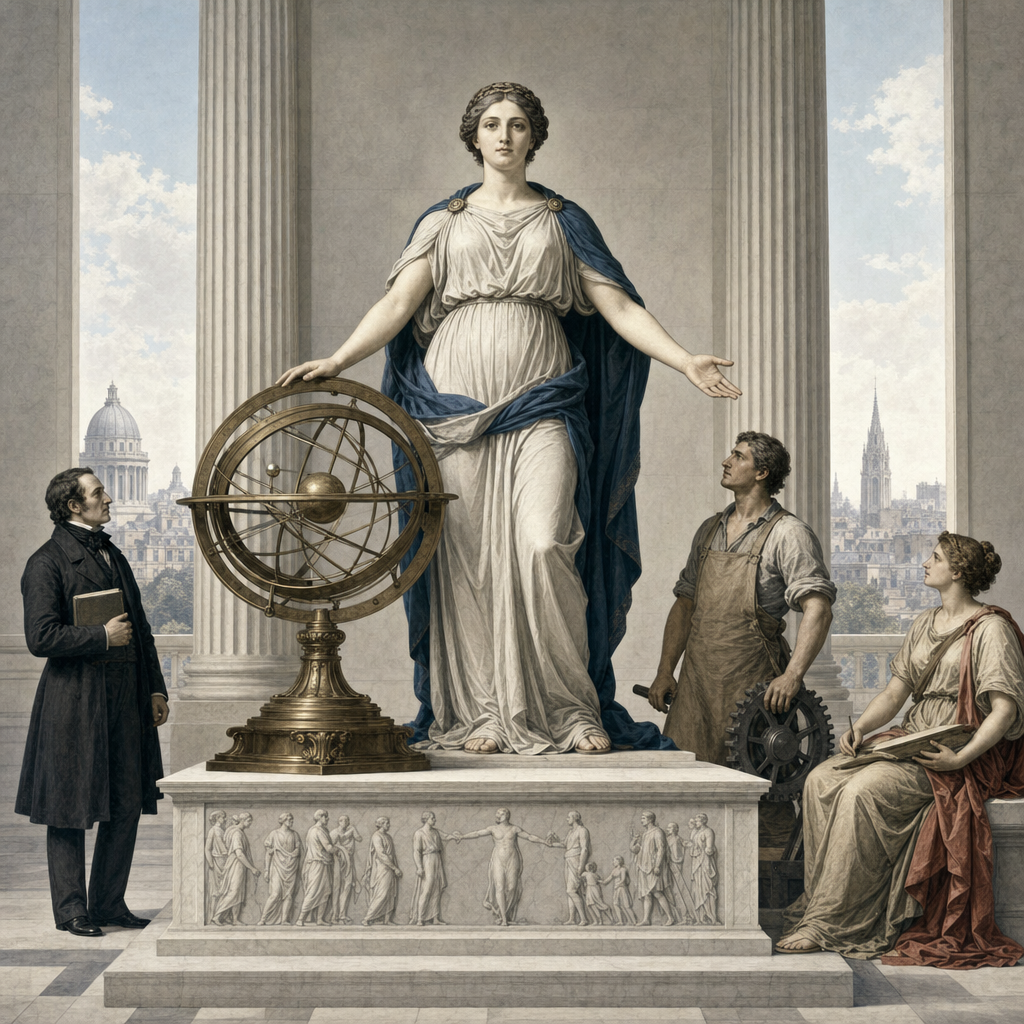
Comte's own summary of six chapters of argument is characteristically compressed into three words. Love supplies the motive, Order the constraint, Progress the direction — and each of the preceding chapters, on his account, has shown a different facet of the same underlying unity.
Love, then, is our principle; Order our basis; and Progress our end.
Humanity as the New Great Being
What theology directed toward God, Comte redirects toward Humanity itself — understood not as the sum of all living people but as the continuous, cumulative achievement of everyone, past and present, whose lives have genuinely served the collective good. Devotion to this Great Being, he argues, does everything the old religions did — orients conduct, supplies consolation, demands service — without requiring belief in anything beyond the natural order Positive science actually describes.
Why Comte Calls It a Religion at All
Comte insists Positivism is not merely compatible with religious feeling but is itself a religion, complete with worship, ritual, and priesthood, because he believes a purely negative, critical philosophy cannot hold society together. Feeling needs a settled object, not just an absence of superstition to react against. Whether this makes Positivism a serious rival to the religions it hoped to succeed, or a philosophy straining unconvincingly to borrow religion's emotional force, is the question that has followed the book since its first publication.
Drawn from Chapter VI of A General View of Positivism (1848), "Conclusion: The Religion of Humanity" — the chapter that gives the Positivist calendar and liturgy, developed at length in the later System of Positive Polity, their philosophical justification.
Related Concepts