A Providential Founding
Bensalem's Christianity arrives, the governor explains, by miracle rather than mission: a pillar of light and a floating ark carrying scripture and a letter from the Apostle Bartholomew, understood by every nation present through a gift of tongues. Bacon grants his utopia a founding as marvellous as any in scripture, establishing its moral legitimacy before a single law of the land is described.
Isolation as Policy
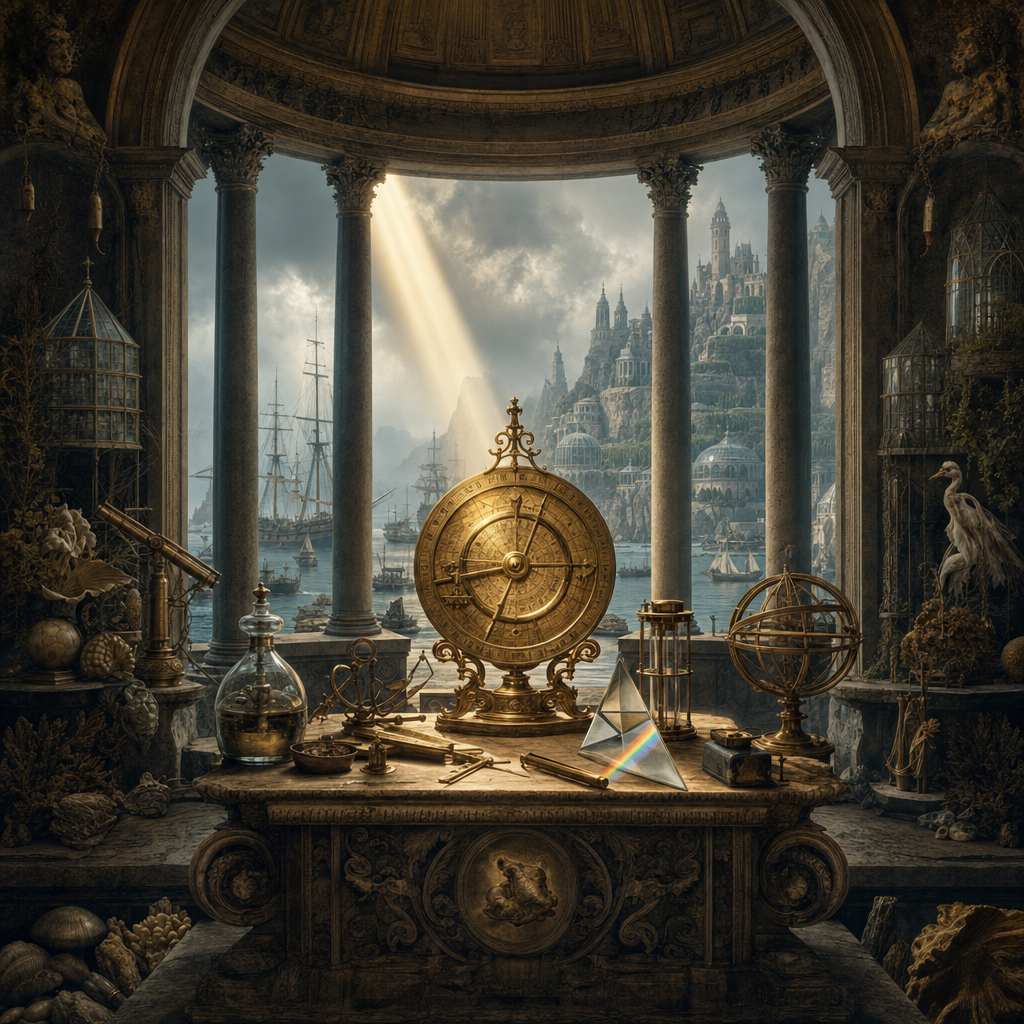
King Solamona, Bensalem's great lawgiver, deliberately cuts the island off from the world's navigation while still sending secret agents — the Merchants of Light — abroad to gather learning. The governor is explicit that this traffic serves one purpose only: not treasure, but knowledge itself, gathered from every part of the world and brought home.
we maintain a trade not for gold, silver, or jewels; nor for silks; nor for spices; nor any other commodity of matter; but only for God's first creature, which was Light
A Utopia Built Around a Laboratory
Every institution the travellers encounter — the Strangers' House, the Feast of the Family, the laws on marriage relayed by Joabin the Jew — turns out, on inspection, to serve or mirror the same underlying commitment: an ordered society is one capable of sustaining patient, well-organised inquiry into nature. Bacon left the work unfinished, without ever describing Bensalem's laws of government in full, as if the political scaffolding mattered to him only insofar as it kept Salomon's House standing.
Drawn from Chapters I–II of New Atlantis, covering the travellers' reception and the governor's account of the island's Christian founding and policy of guarded openness.
Related Concepts