The End of the Foundation
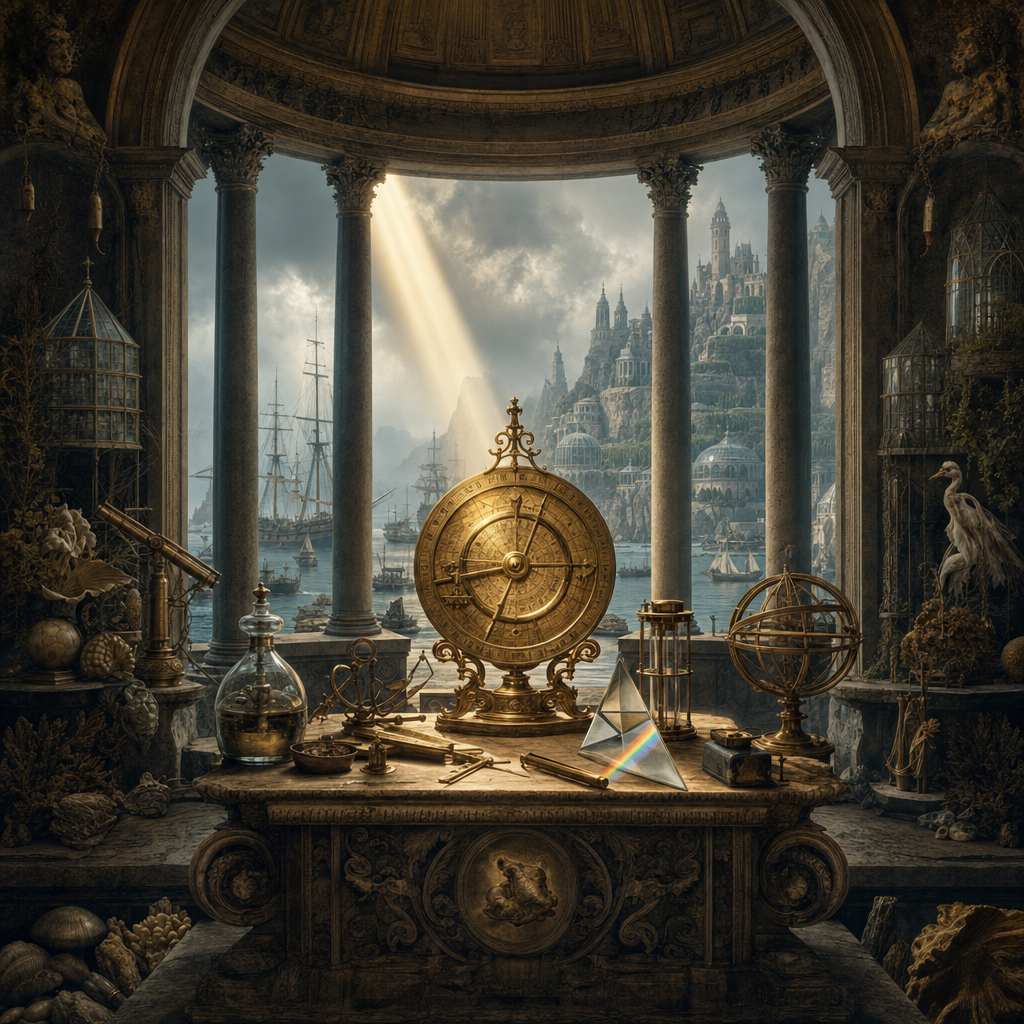
When the Father of Salomon's House finally explains its purpose, he states it in a single sentence that reads like a mission statement: knowledge is to be pursued not for contemplation's sake but for power over nature, exercised for human benefit. This is Bacon's signature move throughout his career — turning philosophy from a spectator's activity into a working one.
The end of our foundation is the knowledge of causes, and secret motions of things; and the enlarging of the bounds of human empire, to the effecting of all things possible.
A Division of Labour for Discovery
What follows is the most striking part of the utopia: not a catalogue of inventions but a catalogue of jobs. Merchants of Light travel abroad gathering foreign learning; Depredators mine existing books for experiments; Pioneers try new experiments; Compilers organise the results into tables; Lamps direct deeper investigations; Inoculators carry them out; Interpreters of Nature draw out the general axioms. Bacon is describing, a generation before the Royal Society existed, what an institution for producing knowledge would actually have to look like on the inside.
A Second Solomon
The House takes its name, the governor explains, from the biblical Solomon — author of a lost natural history 'from the cedar of Libanus to the moss that groweth out of the wall.' Bacon fuses the ambition of scriptural wisdom literature with the empirical programme of his own Great Instauration: a king who catalogued creation becomes the patron of an order that means to finish the catalogue.
the erection and institution of an Order or Society, which we call Salomon's House; the noblest foundation (as we think) that ever was upon the earth
Drawn from Chapters II–III of New Atlantis, where the governor and then the Father of Salomon's House describe the institution's founding and purpose.
Related Concepts