Surface Grammar as Misleading
Consider three sentences: "The table is brown", "The present King of France is bald", "The average family has 2.4 children". Grammatically, all three have the same form — subject-predicate — and seem to attribute a property to an object. But their logical forms differ dramatically. The first is a straightforward predication. The second, on Russell's analysis, is an existential and uniqueness claim that is simply false. The third does not attribute a property to any object at all — "the average family" does not refer to any family. If we read all three as having the same logical form, we will make mistakes about what the world must contain if the sentences are true.
Analysis as the Philosophical Method
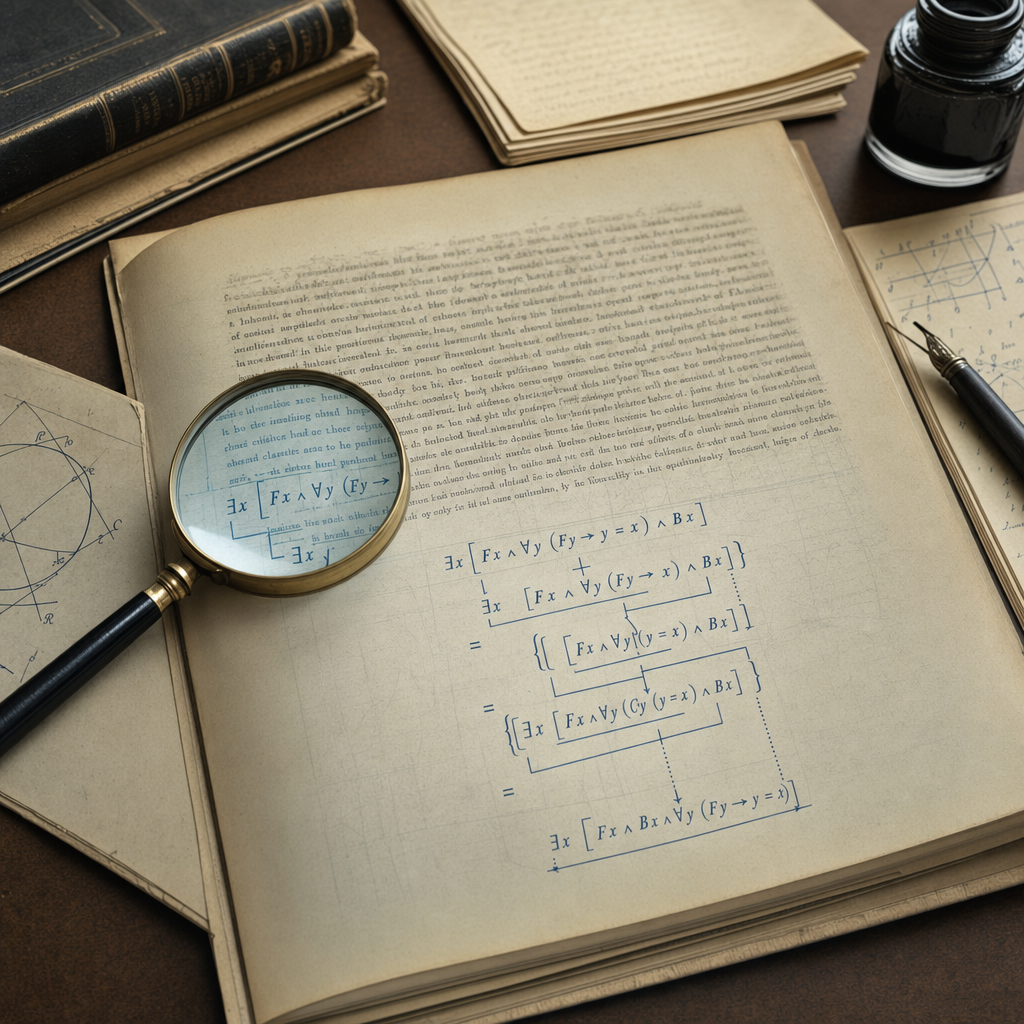
Russell's response is that philosophical problems are often generated by the failure to distinguish logical form from grammatical form. Many metaphysical puzzles dissolve when we look past surface grammar to the real logical structure of the problematic sentences. The method of logical analysis — which Russell pioneered and Wittgenstein developed in the Tractatus and later criticised in the Investigations — involves translating ordinary-language sentences into a canonical notation (predicate logic) that makes their logical commitments perspicuous. What survives this translation is what the sentence really claims; what cannot be translated is either confused or meaningless.
Names and Their Substitutes
The distinction between logical and grammatical form is sharpest in the case of names. Grammatically, "Pegasus" and "Socrates" function identically — both appear as subjects of predication. But "Pegasus does not exist" is true while "Socrates does not exist" (understood in the present tense about the historical individual) is false. For Russell, genuine "logically proper names" — terms that directly refer to their objects — are rare: they are confined to terms for things we are directly acquainted with. Most apparent names, including "Socrates" and "Pegasus", are covert descriptions and should be analysed as such. The category of direct reference is much narrower than ordinary language suggests.
The distinction between logical and grammatical form is implicit throughout Russell's logical work and explicit in the Introduction to Mathematical Philosophy (1919), Chapter 16. Wittgenstein's Tractatus Logico-Philosophicus (1921) develops and radicalises it; his Philosophical Investigations (1953) later attacks it.
Related Concepts