Against the Augustinian Picture
The Investigations opens with a passage from Augustine's Confessions: as a child, Augustine learned language by watching adults name things and imitating them. Wittgenstein takes this as his target — not Augustine personally, but the picture of language it embodies: that every word has a meaning, that meanings are the objects words stand for, that language is fundamentally an act of naming. This picture, he argues, is deeply misleading. It may fit nouns like "apple" and "table," but what does it say about "five," "not," "perhaps," or "pain"?
A Plurality of Uses
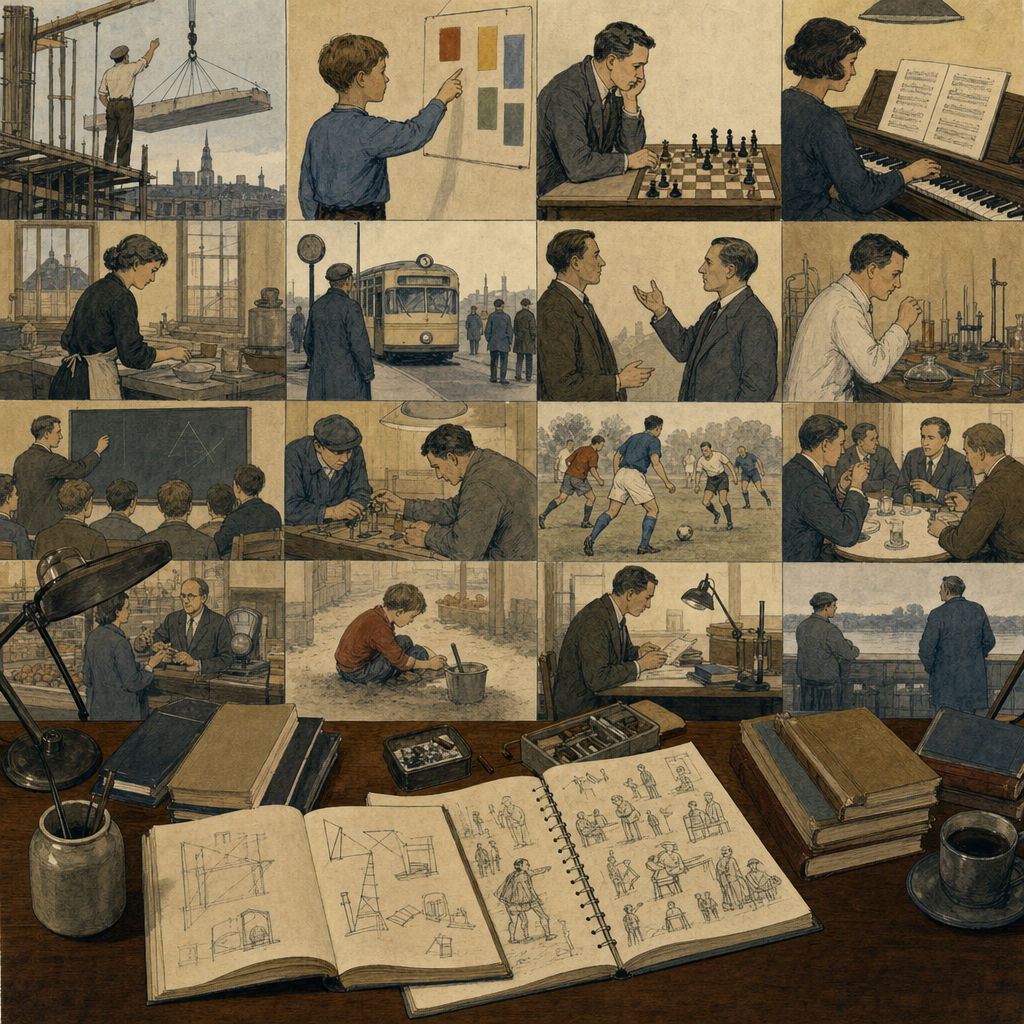
Language is not one thing but many. We give orders, describe objects, report events, speculate, tell stories, act in plays, sing, translate, ask, thank, curse, pray. Each of these activities is a language game: a rule-governed practice in which words have roles determined by their place in the practice, not by any hidden mental accompaniment. The builder's use of "slab!" and "beam!" in coordinating construction work is as much a language game as the logician's use of quantifiers and predicates — neither more nor less "real" as language.
Forms of Life
Language games are embedded in forms of life — the shared practical and cultural contexts that make them possible. To understand a language game is to be at home in a form of life. This is why translation between radically different cultures is so difficult: it is not merely a matter of matching words to meanings but of entering a different way of living and acting. Philosophy goes wrong when it abstracts language away from the forms of life in which it functions and asks timeless questions about "what words really mean."
Language games are introduced in §§1–42 of the Investigations. The concept of forms of life appears at §§19, 23, and 241. Wittgenstein's famous remark that "if a lion could talk, we could not understand him" (p. 235) is the most compressed statement of the doctrine.
Related Concepts