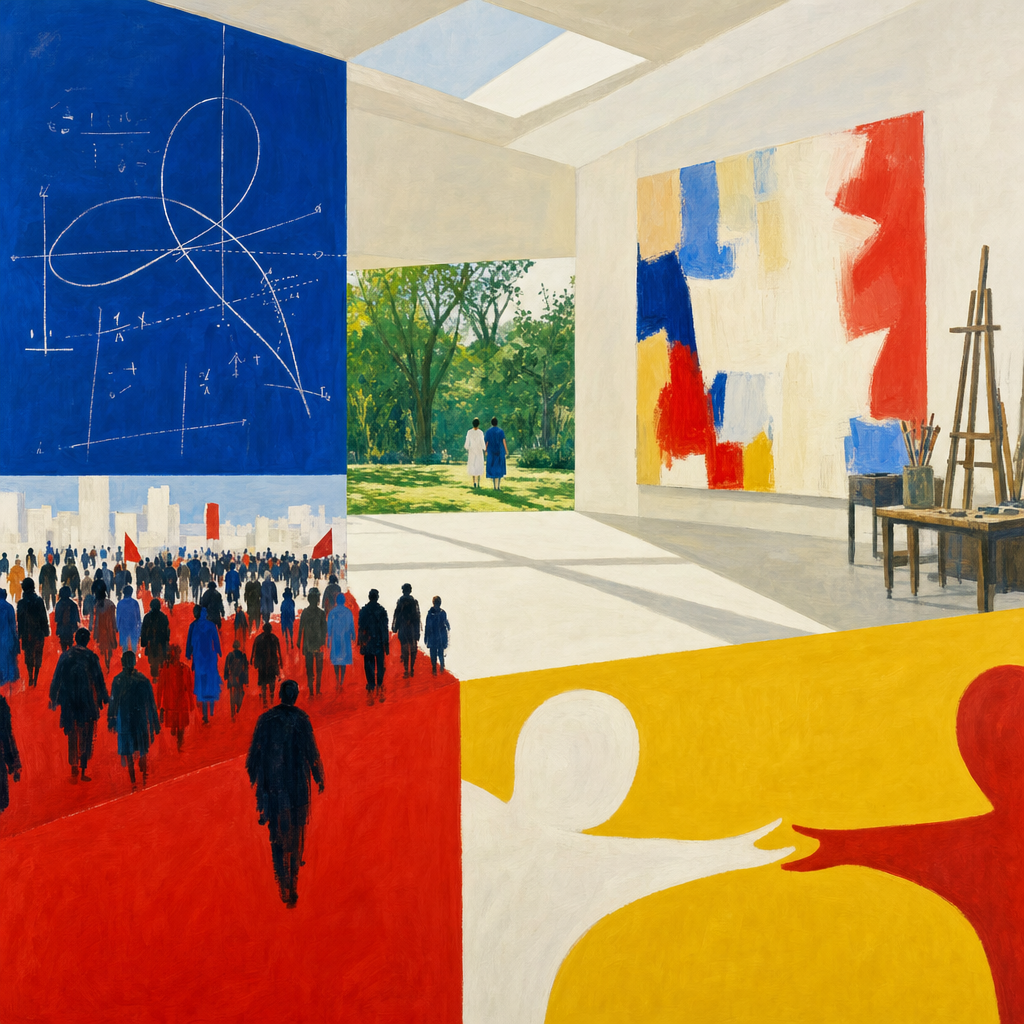
Manifesto for Philosophy (Manifeste pour la philosophie) is Badiou's most polemical and programmatic text — a compressed, deliberately combative statement of what philosophy is, why it is in crisis, and what it must do to recover its vocation. The Manifesto is directed against what Badiou calls the 'age of the poets': a period in which philosophy has abdicating its own task and taking refuge in commentary, hermeneutics, and the mystical evocation of language and being — a tendency Badiou associates above all with Heidegger and his heirs (Derrida, Gadamer, Lacoue-Labarthe). Against this retreat, Badiou asserts that philosophy's proper task is to think the compossibility of its four 'conditions' — the generic procedures of truth in mathematics, politics, art, and love — and to affirm, from this compossibility, that there are truths and that they are unconditional. Philosophy does not produce truths itself; it is conditioned by the truth procedures that arise outside it; but it thinks their co-belonging and maintains the concept of Truth as a category distinct from knowledge, opinion, and interpretation. The Manifesto is also a declaration of Badiou's own philosophical project: the ontology of the event, the theory of the subject, and the Platonist commitment to eternal truth that would be developed in Being and Event and its sequels.
This work isn't available here yet. In the meantime you can purchase a copy on Amazon, or check back later, as we are always adding books to our library.
As an Amazon Associate we earn from qualifying purchases.