Two Fundamental Triangles
Plato begins with triangles as his ultimate material. Two kinds matter: the right-angled isosceles triangle (half of a square) and the right-angled scalene triangle that is half of an equilateral. From these two building blocks, four regular solids are constructed. Three elements — fire, air, and water — are built from the scalene triangle, which means they can transform into each other. Earth is built from the isosceles triangle, and so cannot be converted into the other three: it is locked into its own structure.
Let it be agreed, then, both according to strict reason and according to probability, that the pyramid is the solid which is the original element and seed of fire; and let us assign the element which was next in the order of generation to air, and the third to water.
Form Explaining Property
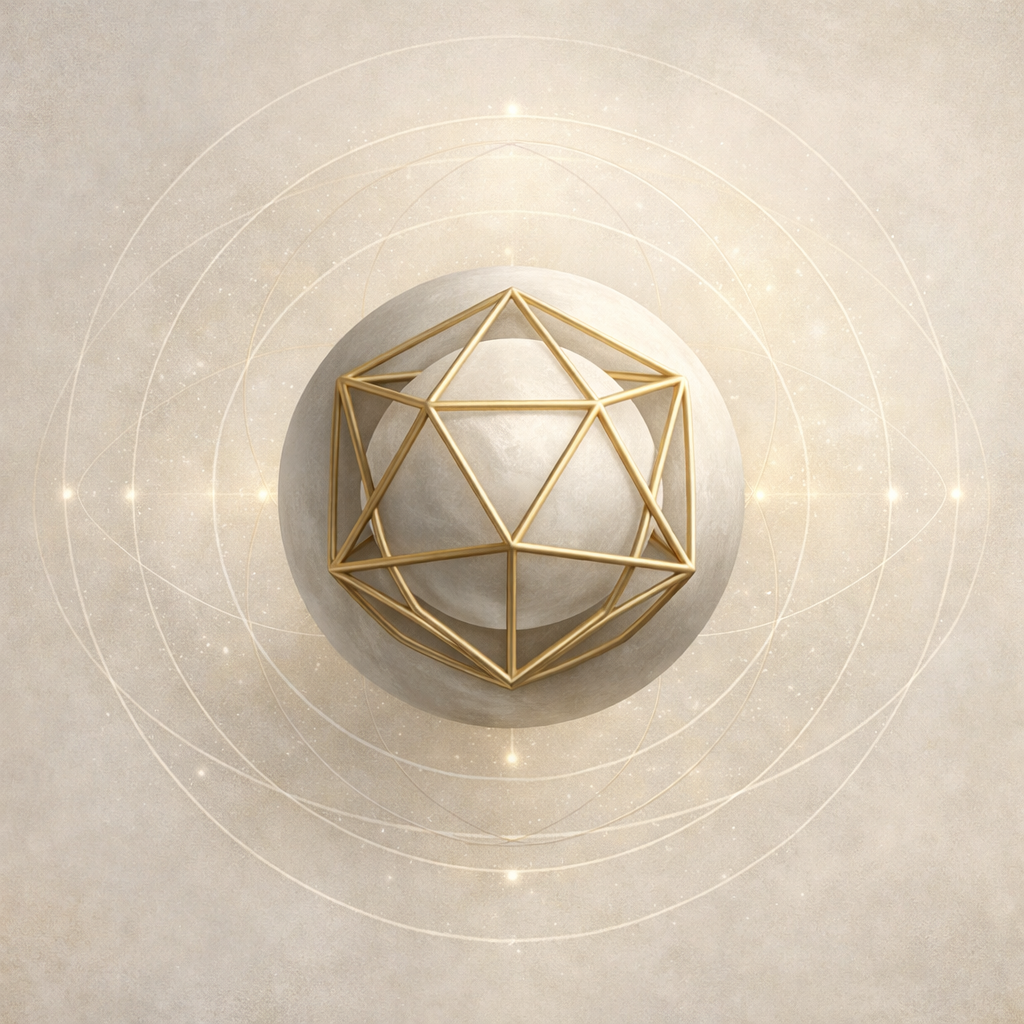
The assignments are not arbitrary. Fire is a tetrahedron (pyramid) — the smallest, most acute, most penetrating of the regular solids. Its sharpness explains why it cuts through flesh and why we feel it as hot and painful. Air is an octahedron, less acute and larger. Water is an icosahedron, the most nearly spherical and so the most fluid, rolling through the other elements. Earth is a cube: the most stable base, the most resistant to motion, the element that stays where it is placed.
This is Plato's most ambitious attempt to reduce qualitative experience to mathematical structure. The hotness of fire is not an irreducible quality but the experience of very small acute pyramids puncturing the skin. The wetness of water is the experience of many-faced near-spheres slipping past one another. The solidity of earth is the experience of cubic forms that resist displacement. Quality follows from geometry.
A Mathematical Physics
This programme anticipates the dream of early modern science: to explain nature mathematically. But Plato's mathematics is not calculus or dynamics — it is stereometry, the geometry of solids. And his purpose is not prediction but intelligibility: the elements are shown to be rational, to follow from principles that reason can grasp, rather than being brute inexplicable givens. The cosmos is not merely beautiful on its surface; its deepest structure is the structure of a proof.
The geometry of the elements appears in Chapter 3 of the Timaeus. The construction of the five regular solids — four used for the elements, one (the dodecahedron) for the heavens — became known as the 'Platonic solids'. Kepler's Mysterium Cosmographicum (1596) attempted to use them to explain planetary orbits, the last major revival of the Platonic programme of geometrical physics.
Related Concepts