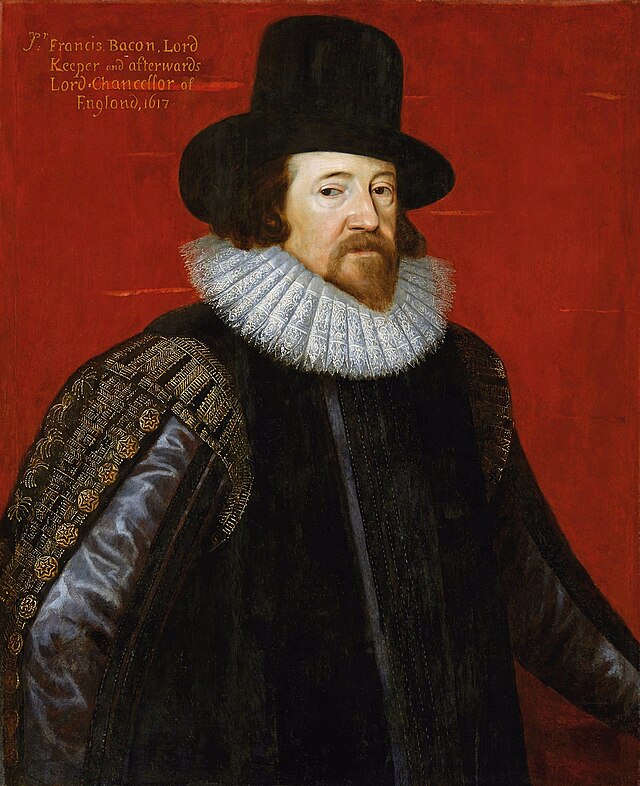
Beyond Efficient Causes
Bacon distinguishes the physicist's question — what mixture of air and water causes the whiteness of snow? — from the metaphysician's: what is the form of whiteness itself, the general nature that, wherever it is instantiated, produces that quality? An efficient cause, he insists, is only ever 'vehiculum formæ' — a vehicle for the form, not the form itself.
the invention of forms is of all other parts of knowledge the worthiest to be sought, if it be possible to be found
A Correction of Plato
Bacon credits Plato with glimpsing that forms are the true object of knowledge, but faults him for abstracting forms entirely from matter and drifting into theology. Bacon's own forms stay tethered to nature — an alphabet of basic qualities (motion, colour, density, heat) from which every particular substance is compounded, waiting to be spelled out by careful inquiry rather than intuited from above.
Drawn from Chapter III of The Advancement of Learning (Book II, section VII), on the second part of metaphysic.
Related Concepts