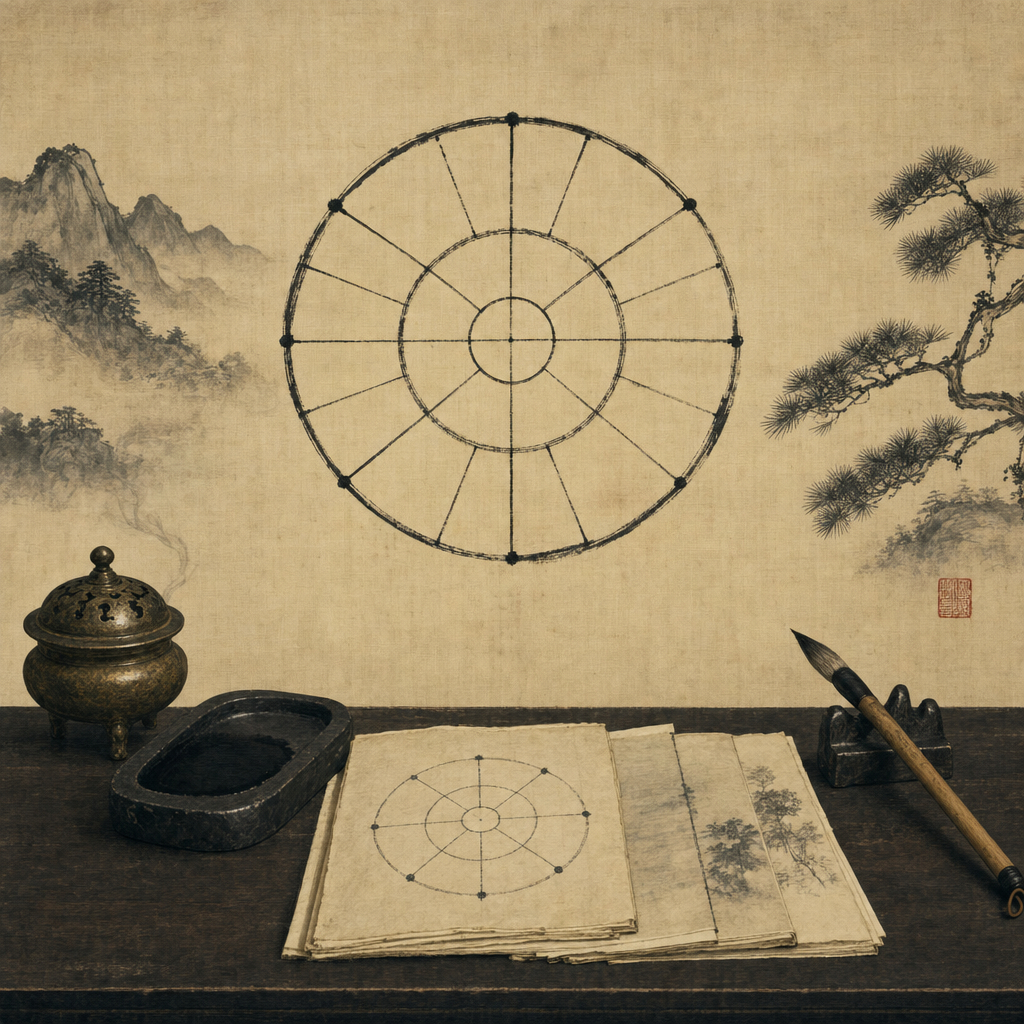
The Ten Diagrams on Sage Learning (Sŏnghak Sipro) is Yi Hwang's masterwork and one of the greatest texts of the Korean Neo-Confucian tradition. Composed in 1568 as a memorial to King Sŏnjo, it presents the essential teachings of Neo-Confucianism through ten diagrams — visual schemas accompanied by explanatory essays — arranged from cosmology to personal moral cultivation. The first five diagrams address the nature of reality: the Supreme Ultimate, the Western Inscription of Zhang Zai, the Elementary Learning, the Great Learning, and the Rules of the White Deer Grotto Academy. The second five address the cultivation of mind and heart: the moral mind and human mind, the nature of humanity and principle, the learning of the mind-and-heart, the mutual cultivation of reverence and righteousness, and the conduct of the student. Yi Hwang drew on the diagrams of earlier Neo-Confucian masters — Zhou Dunyi, Zhu Xi, Cheng Yi — and offered his own emendations and commentary, correcting what he saw as misinterpretations in earlier Korean scholarship. The work synthesises a complete vision of Confucian self-cultivation within a framework that moves from the cosmic to the personal, from metaphysics to ethics to daily practice. It became the foundational pedagogical text of the Chosŏn dynasty and remains a touchstone of Korean philosophy.
This work isn't available here yet. In the meantime you can purchase a copy on Amazon, or check back later, as we are always adding books to our library.
As an Amazon Associate we earn from qualifying purchases.