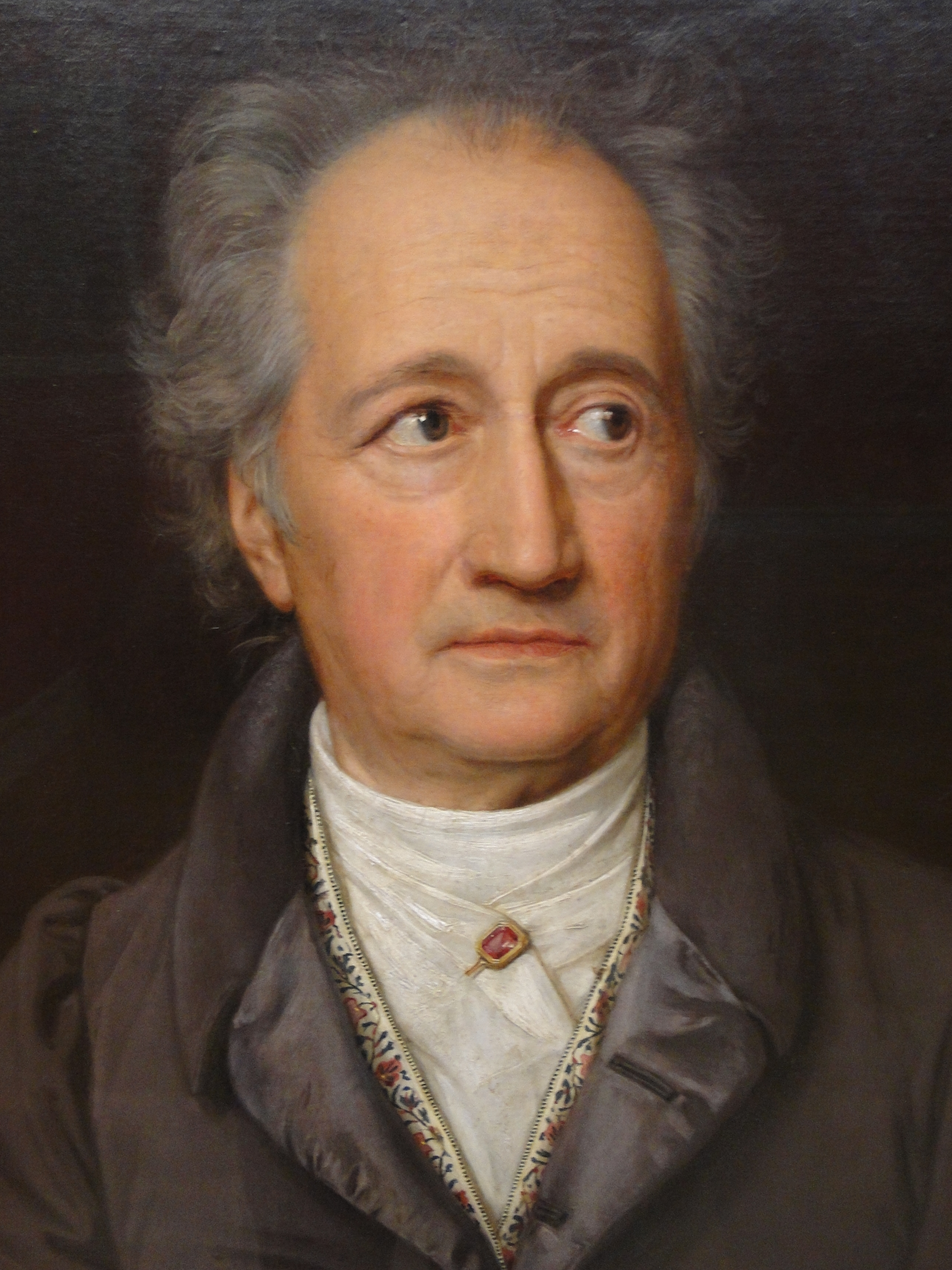
Johann Wolfgang von Goethe
Johann Wolfgang von Goethe was the towering figure of German intellectual life from the 1770s to his death in 1832—poet, novelist, playwright, natural scientist, and philosopher. His philosophical importance lies in his opposition to Newtonian mechanistic science, which he believed distorted nature by reducing it to mathematical abstractions, and in his development of a morphological science that sought to understand living forms as self-organising wholes on their own terms.
Goethe's Theory of Colours argued that colour arises in the interaction between light, darkness, and the perceiving eye—a phenomenological claim that influenced Schopenhauer and Wittgenstein. His concept of the Urpflanze and his morphological method anticipated later approaches in developmental biology. Faust dramatises the restless striving of the modern spirit and remains the great philosophical poem of German culture. His influence on German Romanticism, Idealism, and the philosophy of nature was immeasurable.