Directory › Franz Rosenzweig
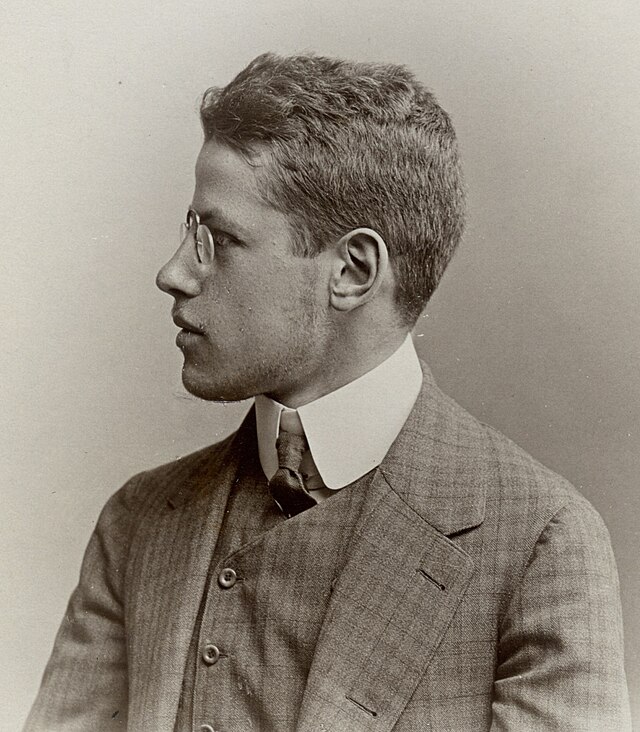
Franz Rosenzweig
Jewish Philosophy
1886–1929 · Contemporary
Franz Rosenzweig was the German-Jewish philosopher whose masterwork The Star of Redemption — written as field postcards from the Macedonian front during the First World War — is one of the most original and demanding philosophical texts of the twentieth century. Rosenzweig developed a "new thinking" that replaced the idealist's abstract totality with three irreducible elements: God, World, and the human being, brought into relation through creation, revelation, and redemption.
Rosenzweig's thought was born from a near-conversion to Christianity: on the brink of baptism, he returned to Judaism — not to the synagogue he knew but to a Judaism discovered anew. He subsequently devoted himself to adult Jewish education, founding the Freies Jüdisches Lehrhaus in Frankfurt, and to translating the Hebrew Bible into German with Martin Buber. Stricken with progressive paralysis from 1922, he continued to write and translate while almost completely paralysed, dictating with eye movements to his wife until his death at forty-three.
Speech thinks for us; it does not allow us the luxury of separating thought from the time it takes. To think is to wait for what will come.
0
Books
20
Related
0
Concepts